
You built a great Squarespace website. You’re getting traffic. And yet, most of those visitors leave without doing a single thing you wanted them to do.
No email signup. No inquiry. No purchase.
Here is the uncomfortable truth: a beautiful website without a conversion mechanism is just a digital brochure. Popups are one of the most direct ways to fix that. Done right, they capture emails, promote offers, and recover abandoned visitors, without killing your user experience.
I’ve tested both Squarespace’s built-in popup tool and advanced popup builders like Picreel on Squarespace.
In this guide, I’ll show you exactly how to set up a popup using both methods, which one is worth your time depending on your goals, and the best practices that actually move the conversion needle.
What Is a Squarespace Popup & Does It Work?
So does it actually work?
The short answer is yes, popups work. The longer answer is that they work when they are well-timed, targeted, and built around a genuine offer. The rest of this guide is about getting there.
How to Add Advanced Popups to Squarespace Using Popup Tool
Before I walk you through Squarespace’s built-in tool, I want to show you the method I personally recommend for anyone serious about conversions. Picreel is a dedicated popup builder that works across any website platform, including Squarespace.
It gives you exit-intent popups, A/B testing, behavioral targeting, and 100+ integrations that Squarespace’s native tool simply does not offer.
Brands like Foundr have used Picreel to capture tens of thousands of additional leads by targeting visitors at the right moment. In one campaign alone, they converted over 20,000 extra visitors into training signups using exit-intent popups and relevant offers.

The setup takes under 30 minutes and you don’t need to write a single line of code. Here is exactly how I do it.
Step 1: Define Your One Goal
Every popup should do exactly one thing. Capture an email. Promote an offer. Recover a visitor about to leave. The moment you try to do two things at once, the message gets muddy and your conversion rate drops.
Before you open Picreel, get clear on the goal. You can use this prompt in ChatGPT or Gemini to pressure-test your idea:
“The only action I want this visitor to take right now is ___. On a scale of 1 to 10, how likely is a visitor on the [page name] page to want this? If the answer is below 7, rethink the offer or the page.”
If the score comes back low, adjust the offer or pick a different page to run the popup on.
Step 2: Pick Your Popup Type and Trigger
Based on your goal, match it to a popup type and trigger. If you want to recover abandoning visitors from your Squarespace store, you need an exit-intent popup with a discount.
If you want to capture leads from a blog post, a scroll-depth popup with a content-matched lead magnet will outperform a timed popup almost every time.
The combination of type and trigger matters more than the design at this stage. I cover the full breakdown in the popup types section below.
Step 3: Build It in Picreel
Sign up for a free Picreel account and create a new campaign. You have two paths here.
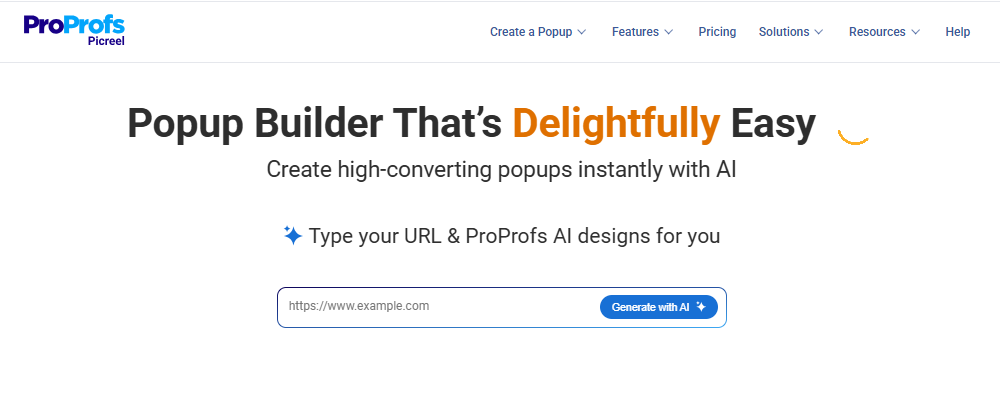
If you want speed, use Picreel’s AI Popup Builder. Enter your Squarespace website URL, select your goal, and the AI generates a matching popup layout, copy, and CTA automatically based on your page.
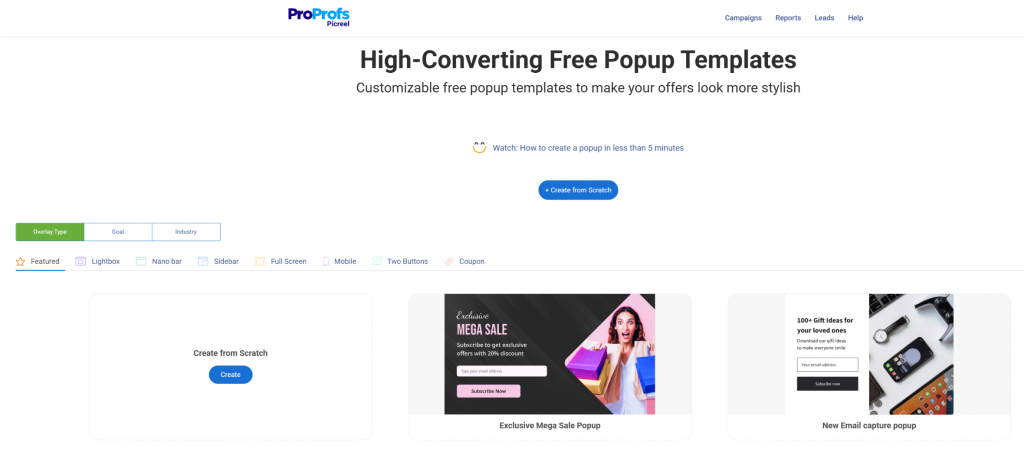
If you want more control, open the Drag and Drop Popup Builder and choose from popup templates including lightboxes, slide-ins, nanobars, Wheel of Fortune, and full-screen overlays. Customize the design directly on the canvas.
A few things that directly impact your conversion rate at this step:
- Ask for email only on first-touch popups. Adding a name field reduces opt-in rate meaningfully.
- Write a benefit-driven headline. “Get weekly Squarespace conversion tips” consistently outperforms “Subscribe to our newsletter.”
- Use action-oriented CTA copy. “Send me the guide” converts better than “Submit.”
- Upload a lead magnet image if you’re offering a free resource. Visible value increases signups.
You can also use this headline prompt before writing your copy:
“My visitor is on [this page] and they care about [specific problem]. The one thing I can offer them right now that solves that problem is [offer]. Write three headline variations that lead with the benefit, not the format.”
Step 4: Set Your Trigger and Targeting Rules
This is the step most people rush. Picreel’s Smart Popup Triggers and Advanced Targeting let you get very specific about when and to whom your popup appears.

Target by:
- Page URL: Show a cart abandonment popup only on checkout pages, not site-wide.
- Traffic source: Show a different offer to visitors from paid ads versus organic search.
- Device type: Create a simplified version for mobile with fewer fields.
- New vs. returning visitors: Don’t show an email capture popup to someone already on your list.
For frequency rules, use these as your baseline:
| Setting | Recommended Value |
| Show popup after X seconds | 15 to 25 seconds |
| Frequency cap per visitor | Once every 7 days |
| Hide after form submission | Always |
| Exit-intent delay after last shown | 3 days |
Picreel’s Exit Intent Triggers are particularly powerful here. They detect the exact moment a visitor’s cursor moves toward closing the tab and fire the popup right before they leave. Squarespace’s native tool has no equivalent of this.
Step 5: Connect Your Email Marketing Tool
Go to Integrations inside your Picreel campaign and select your platform. Picreel integrates with Mailchimp, ActiveCampaign, Klaviyo, HubSpot, Salesforce, Constant Contact, AWeber, and 90+ other tools.
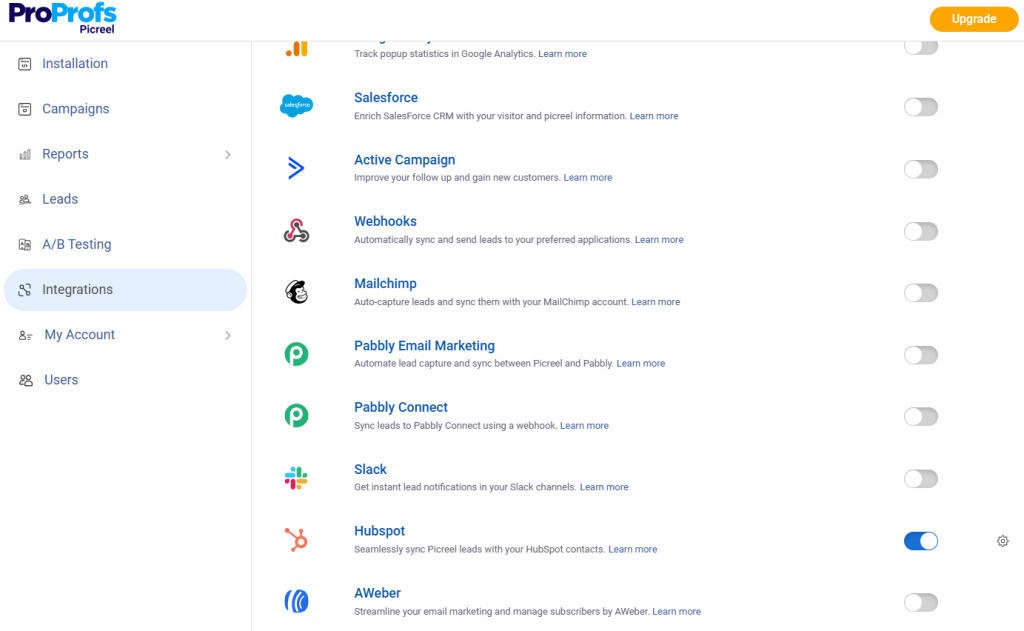
Map the email field from your popup form to the corresponding field in your email list and save. Every new subscriber flows automatically into your list from this point. No CSV exports. No manual imports.
One thing most marketers skip and later regret: tag every lead with the popup they converted on. A lead who opted in through a “Free Squarespace Checklist” popup is in a completely different mindset than someone who came through a “10% Off” popup. Different tags, different welcome sequences, and much better downstream conversions.
Step 6: Embed Picreel Code Into Your Squarespace Site
Getting Picreel live on your Squarespace site takes under five minutes.
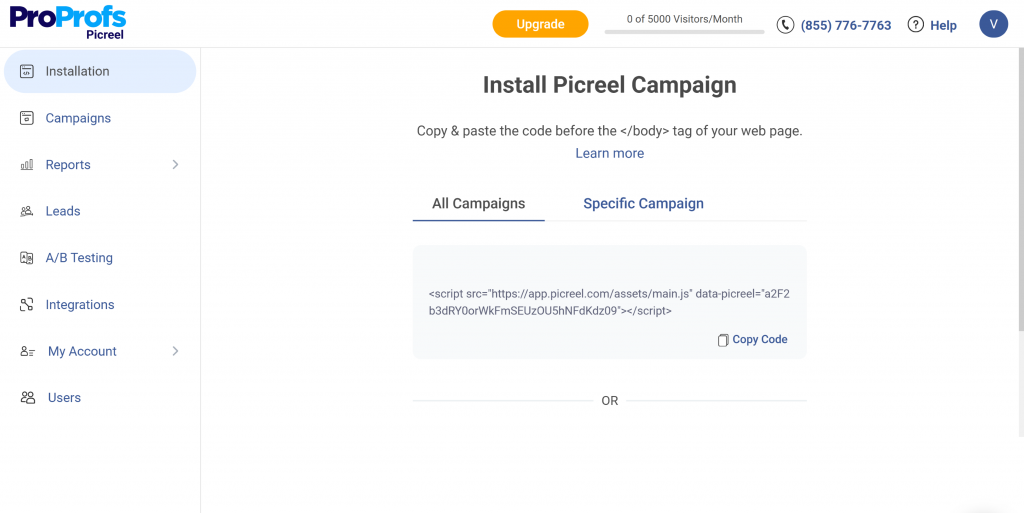
- Inside Picreel, navigate to your campaign and click “View Code.”
- Click the code snippet to copy it.
- In your Squarespace editor, go to Website and view your pages list.
- Hover over the page where you want the popup to appear and click the Settings icon.
- Go to Advanced to access the code injection field.
- Paste the copied code into the blank section and click Save.
- Preview your site to confirm the popup renders correctly.
- Publish your site for the changes to go live.
For a site-wide popup (showing on all pages), use the code injection field in Settings > Advanced > Code Injection > Header instead of adding it page by page.
Step 7: Monitor Performance and Optimize
Once your popup is live, Picreel’s Real-Time Analytics dashboard tracks impressions, clicks, and conversion rate as it happens. In the first week, note which pages drive the highest conversion rate.
Here is how to read the numbers:

- Below 1.5%: Your offer, timing, or targeting needs work.
- 1.5% to 3%: Decent but has room to improve. Test the headline or the trigger timing.
- 3% to 8%: Well-optimized. You are in line with the top performers across benchmarks.
- Above 8%: You are in top-performer territory. Clone this campaign and apply the same targeting logic to more pages.
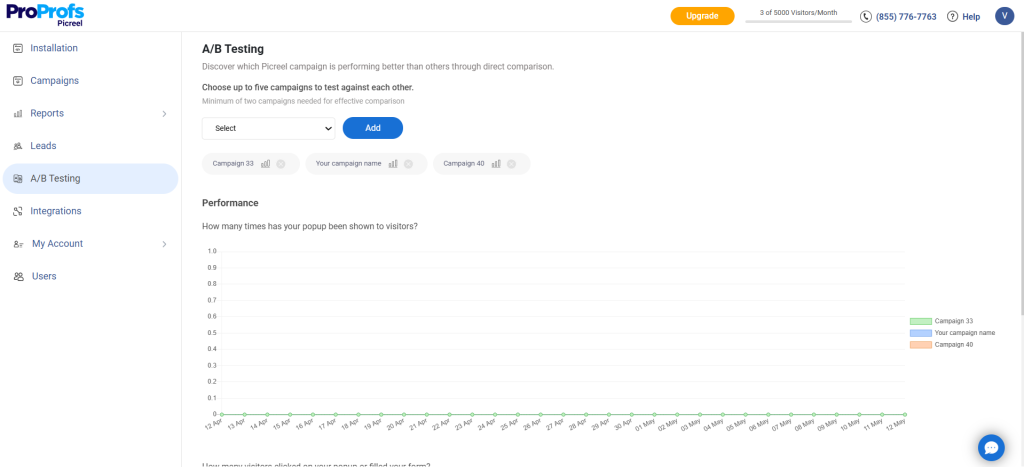
Use Picreel’s A/B Testing feature to run two variants of your popup simultaneously. Test one variable at a time: headline copy, CTA text, offer type, or trigger timing.
How to Add a Popup on Squarespace Using the Built-in Tool
If you want a simple popup without adding another tool, Squarespace’s native Promotional Popup works well for basic use cases like email capture or announcements. It’s easy to set up and fits seamlessly into your site.
That said, it’s best suited for straightforward campaigns. As your needs grow like running multiple offers, targeting visitors differently, or optimizing performance you may start to feel its limitations.
Here’s how to set it up step by step.
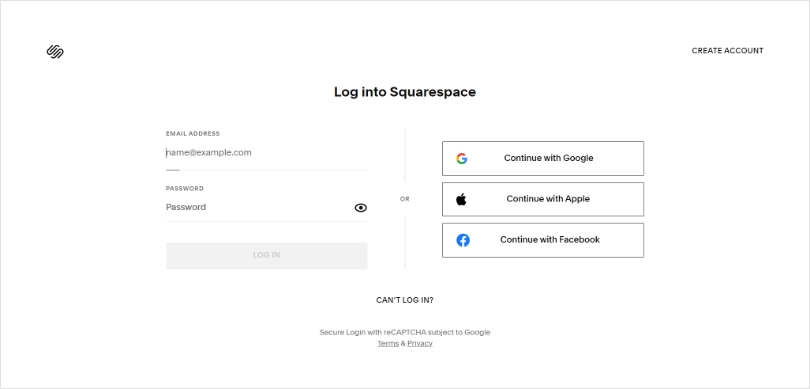
Step 1: Log in to Squarespace and go to your website dashboard.
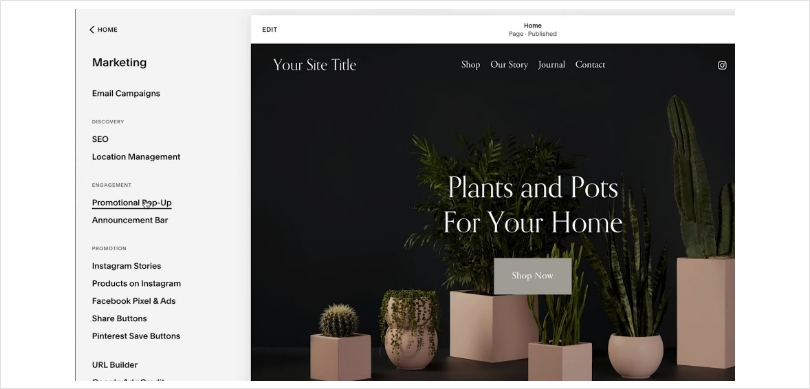
Step 2: Navigate to Marketing > Marketing Tools > Promotional Pop-up. If you can’t find it, press the forward slash (/) key on your keyboard and search “Promotional Pop-up.”
Step 3: Choose a layout. Squarespace offers several options including partial-screen and full-screen overlays. I recommend a partial-screen layout.
Full-screen popups that cover the entire page can negatively impact your SEO, especially on mobile, where Google has penalties for intrusive interstitials.
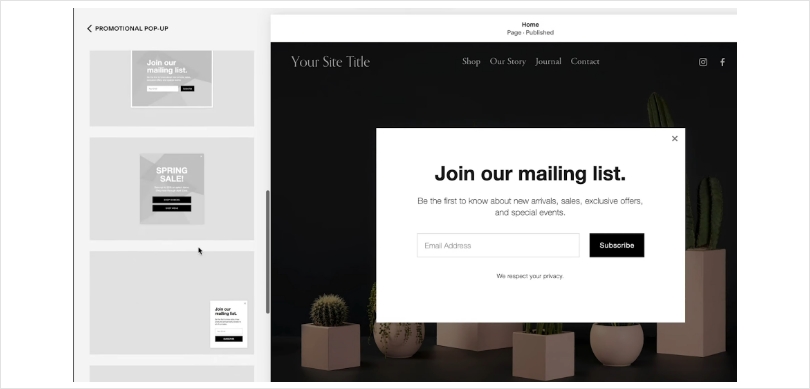
Step 4: Customize your content. In the Content panel, set your headline (one sentence maximum), body text (two to three sentences), and CTA. Keep it focused. One message, one action.
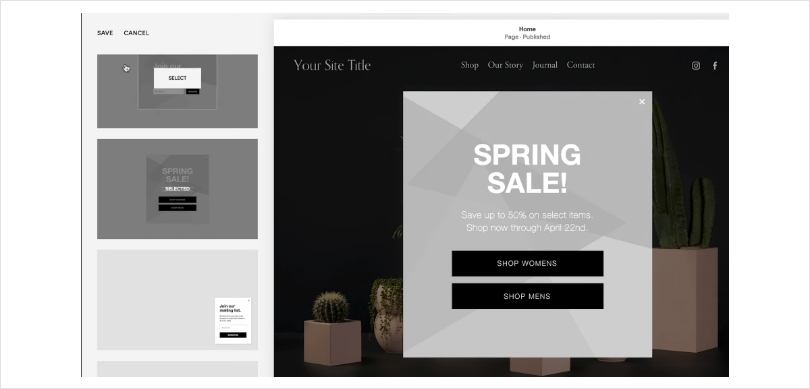
Step 5: Set your trigger. Under Display and Timing, you can choose to show the popup after a time delay (in seconds) or after the visitor scrolls a set percentage of the page. Based on current benchmark data, a 15-second delay is your best starting point.
Step 6: Set display frequency. Choose how often the popup appears to the same visitor: once per session, once per day, or once per week. “Show once per session” prevents the popup from becoming annoying to repeat visitors.
Step 7: Connect your email service. You can connect to Squarespace Email Campaigns, Mailchimp, or collect addresses in a Google Sheet. If you use Flodesk, Kit, or another platform not listed, you’ll need to use the “Click a button” action and link to an external signup page.
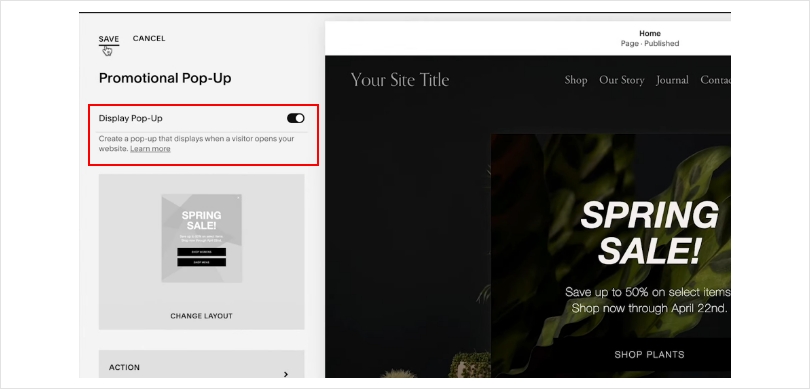
Step 8: Toggle on “Display pop-up” and click Save. Preview your site to confirm everything looks right on both desktop and mobile before publishing.
Comparison: Squarespace Native Popup vs. Picreel
| Feature | Squarespace Native | Picreel |
|---|---|---|
| Exit-intent detection | No | Yes |
| A/B testing | No | Yes |
| Multiple popups at once | No (1 only) | Yes (unlimited) |
| Behavioral targeting | Basic | Advanced (source, device, scroll, history) |
| Email marketing integrations | Mailchimp + Squarespace Campaigns only | 100+ tools |
| Video in popups | No | Yes |
| AI popup builder | No | Yes |
| Works after migrating from Squarespace | No | Yes |
| Free plan available | Included with Core plan ($36/mo+) | Forever free plan available |
What Are Squarespace Popup Best Practices That Improve Conversions?
These are not generic tips. They come from what consistently works when you’re actually running popups on live Squarespace sites. If you get these right, you’ll see better conversions without making your site feel intrusive.
1. Get Your Timing Right
Timing decides whether your popup feels helpful or annoying. On Squarespace, you can easily control this through delay and scroll settings. The goal is simple: show the popup only after the visitor has shown some level of interest.
For content-heavy pages, scroll-based triggers work better because they filter out casual visitors. For landing or product pages, a short delay gives users just enough time to understand what you offer before you ask for action.
| Do | Don't |
|---|---|
| Set popup to appear after 11 to 15 seconds | Fire the popup the moment the page loads |
| Use scroll-depth triggers (40 to 60%) on blog posts | Show the same popup on every single page visit |
| Test scroll vs. time delay and keep what converts higher | Assume one timing setting works for all page types |
2. Lead With a Real Offer
What you offer matters more than how your popup looks. On Squarespace, you’re competing for attention in a clean, design-focused environment, so weak copy gets ignored quickly.
Instead of asking visitors to “subscribe,” give them a clear reason to act. Whether it’s a discount, a checklist, or a useful resource, the value should be obvious within a second. Think of it as an exchange, not a request.
| Do | Don't |
|---|---|
| "Get the free Squarespace launch checklist" | "Subscribe to our newsletter for updates" |
| "Claim your 10% off first order" | "Sign up to stay in the loop" |
| Lead with the specific benefit the visitor gets | Lead with what you want (more subscribers) |
3. Use Images in Your Popup
Squarespace is a design-first platform, so visuals carry more weight here than on most builders. A well-chosen image can instantly communicate what your offer is about without adding more text.
Use visuals that directly support your offer, not just something that looks nice. A product shot, a preview of your resource, or a clean branded visual works far better than generic imagery.
| Do | Don't |
|---|---|
| Show a flat-lay mockup of your lead magnet | Leave the image slot blank to "keep it clean" |
| Use a product image on ecommerce discount popups | Use a generic stock photo unrelated to the offer |
| Match the image style to your Squarespace brand | Use a high-res image that slows popup load time |
4. Keep Form Fields Minimal
Every extra field adds friction. On Squarespace popups, shorter forms feel lighter and are more likely to get completed, especially on mobile.
Start with just the email. Once someone is in your funnel, you can always collect more details later through follow-ups or forms on dedicated pages.
| Do | Don't |
|---|---|
| Ask for email only on your first popup | Ask for name, email, phone, and company upfront |
| Add a second field only on high-intent pages | Treat your popup like a full lead intake form |
| Use progressive profiling to gather more data over time | Assume more fields means more qualified leads |
5. Control Your Frequency
Even a good popup becomes ineffective if it shows up too often. Squarespace lets you control how frequently popups appear, and this is where most people go wrong.
Set clear limits so your popup feels like a reminder, not a repetition. Also make sure people who have already converted don’t keep seeing the same message again.
| Do | Don't |
|---|---|
| Set a 7-day frequency cap for returning visitors | Show the popup on every visit with no cap |
| Hide the popup permanently after a visitor converts | Keep showing the popup to people already on your list |
| Use "once per session" as your default starting rule | Use "every page" frequency on a content-heavy site |
6. Design for Mobile Separately
Squarespace handles mobile popups differently, and that’s a good thing. Instead of forcing desktop layouts onto smaller screens, it simplifies the experience.
Your job is to adapt your message. Keep it shorter, clearer, and easier to interact with. If it takes effort to read or close, users will simply leave.
| Do | Don't |
|---|---|
| Use a partial-screen, bottom-positioned layout on mobile | Use a full-screen popup that blocks all page content |
| Keep mobile headline to one short, punchy sentence | Copy your desktop popup to mobile without changes |
| Make the close button large and obviously visible | Hide or minimize the close button to force engagement |
7. Start on Your Highest-Traffic Pages
Rolling out popups across your entire site from day one makes it harder to understand what’s working. Instead, start small and learn fast.
Focus on the pages that already get traffic. Once you see how users respond, you can expand with more confidence and better targeting.
8. Add Countdown Timers for Time-Sensitive Offers
Urgency works when it’s real. If you’re running a limited-time offer, a countdown timer gives visitors a clear reason to act now instead of later.
Use it selectively. When every popup feels urgent, none of them are. But when used at the right moment, it can significantly improve response rates.
FREE. All Features. FOREVER!
Try our Forever FREE account with all premium features!
What Type of Popup Should You Use on Your Squarespace Site?
The type of popup you run should be determined by your conversion goal, not by what looks good. Here is a breakdown of the main popup types, what they are best suited for, and which trigger to pair them with.
| Popup Type | Best For | Recommended Trigger | Popup Offer Example |
|---|---|---|---|
| Email capture | Growing a newsletter list | Time delay: 10 to 15 seconds | Free checklist, newsletter incentive, content upgrade |
| Discount or coupon | Ecommerce, first-time buyers | Exit-intent or page entry | 10% off, free shipping, first-order discount |
| Lead magnet | Bloggers, coaches, freelancers, service businesses | Scroll depth: 50%+ | SEO checklist, templates, swipe files |
| Announcement | New product launch, event, limited news | Immediate or time-limited | Early access, launch updates, limited-time info |
| Cart abandonment | Ecommerce stores | Exit-intent on cart or checkout page | Extra discount, free shipping reminder |
| Survey or quiz | Segmentation, personalization, audience research | Page 2+ visit or returning visitor | Personalized results, recommendations |
| Wheel of Fortune | Ecommerce, high-intent pages | Exit-intent or time delay | Spin-to-win discounts, surprise deals |
Turn Your Squarespace Traffic Into Real Conversions
Here is what I want you to take away from this guide.
Squarespace’s built-in popup is a solid starting point if you want something simple and already have a Core plan. It covers basic email capture and announcement use cases without any additional tools or cost.
But if you want to run exit-intent campaigns, test multiple offers simultaneously, target visitors by behavior, or connect your leads to the email platform you actually use, the native tool will hold you back. That is where Picreel earns its place.
It works directly on your Squarespace site, takes under 30 minutes to set up, and gives you the targeting precision and testing capability that moves conversion rates from average to exceptional.
Start with one focused popup on your highest-traffic page, measure results for a week, and optimize from there. You do not need to run 10 campaigns to see results. You need one campaign that is well-targeted, well-timed, and built around an offer your visitors actually want.
Frequently Asked Questions

Does a Squarespace popup work on mobile devices?
Yes, but it displays differently. On mobile, Squarespace automatically removes the image from the popup and positions it at the bottom of the screen rather than the center. This is intentional and follows Google's mobile usability guidelines. You can customize the mobile version using CSS, but in most cases the default behavior is the right call for SEO and user experience.
Will popups hurt my SEO on Squarespace?
It depends on the popup type. Full-screen popups that block the entire page content on mobile can trigger a Google penalty for intrusive interstitials. To stay safe, use partial-screen layouts, make sure the close button is clearly visible, and avoid firing the popup immediately on page load for first-time visitors. Time-delayed, partial-screen popups that are easy to dismiss do not negatively impact SEO.
How do I connect my Squarespace popup to Flodesk or Kit?
Squarespace's native popup only connects directly to Squarespace Email Campaigns and Mailchimp. For Flodesk, Kit, or other platforms, the workaround is to use the "Click a button" action in your popup settings and link to your hosted signup form from that platform. If you want a direct native integration, Picreel connects to 100+ email tools including Flodesk, Kit, ActiveCampaign, and Klaviyo.
What is the difference between a Squarespace popup and an announcement bar?
A popup is an overlay that appears on top of your page content and prompts a direct action like an email signup or CTA click. An announcement bar is a persistent banner that sits at the top of your site and is always visible as visitors browse. Popups are higher-impact and better for one-time conversions. Announcement bars work better for ongoing messaging like free shipping thresholds, seasonal promotions, or site-wide news.
Can I use exit-intent popups on Squarespace?
Not with Squarespace's native popup builder. The native tool only supports time-delay and scroll-depth triggers. Exit-intent detection, which fires a popup when a visitor's cursor moves toward closing the browser tab, requires a third-party tool. Picreel's Exit Intent Triggers handle this and are one of the most effective ways to recover visitors who are about to leave your Squarespace site without converting.
How often should my Squarespace popup show to the same visitor?
The recommended baseline is once per session for most campaigns, with a frequency cap of once every seven days for returning visitors. Showing the same popup on every visit creates popup fatigue and increases the chance visitors start ignoring it or bouncing. If you are running a time-sensitive offer with a countdown timer, you can shorten the frequency to daily, but always hide the popup permanently after a visitor converts.
FREE. All Features. FOREVER!
Try our Forever FREE account with all premium features!

 We'd love your feedback!
What did you like & how can we make it even better?
 Thanks for your feedback!
 Ask Your Question
Have a question? Get expert help to make your decision easier.