

I’ve tested a lot of popup tools over the years, and OptiMonk is one I keep revisiting in conversations with growth marketers.
It does the job for some use cases, but I keep hearing the same frustrations: pricing that scales awkwardly, ecommerce-heavy features that feel irrelevant for SaaS teams, and a learning curve that slows down small teams.
If you’re actively searching for the best OptiMonk alternatives right now, you’re probably dealing with at least one of those issues.
I’ve put together this list based on real testing, community research, and verified user feedback so you can find the right fit fast, whether you’re running an e-commerce store, a SaaS product, or a lead gen agency.
Why Marketers Are Switching From OptiMonk
I’ve aggregated the most consistent frustrations from community research, forums, and G2 reviews. If any of these match what you’re experiencing, you’re in the right place.
1. Pricing that scales in the wrong direction: OptiMonk charges based on pageviews, not sessions or conversions. That means you’re paying for every page load, even when no campaign fires. For high-traffic sites with low monetization rates, the cost compounds fast.
2. Feature gating at key tiers: Advanced targeting rules, UTM-based segmentation, and major integrations like Klaviyo are locked behind higher plans. Teams that want full functionality often find themselves on a plan that costs significantly more than expected.
3. E-commerce-first focus: OptiMonk’s product catalog personalization and Shopify-specific features are strong, but SaaS companies, agencies, and content publishers consistently report that the platform doesn’t map well to their use cases.
4. Site and domain limits: Entry-tier plans restrict the number of domains. For agencies managing client websites or brands running multiple properties, this becomes a recurring problem.
5. Performance impact: Script-heavy popup tools can slow page load times and negatively affect Core Web Vitals. This matters for both user experience and SEO rankings.
10 Best OptiMonk Alternatives for Lead Generation
To make your evaluation easier, I’ve summarized the best OptiMonk alternatives in the table below, highlighting who they’re best for, how users rate them, and what you can expect to pay.
| Tool | Best For | User Rating (Capterra Rate) | Starting Price |
| Picreel | Best for Converting Existing Traffic Into Leads and Sales | 4.5/5 | Free plan available; paid plans start at $9.99/month |
| OptinMonster | Best for Advanced Campaign Management Across All Business Types | 4.2/5 | $7/month |
| Thrive Leads | Best for Maximizing Lead Generation on WordPress | 5/5 | $299/year |
| ConvertBox | Best for Personalized On-Site Messages at Scale | N/A | $495 one-time |
| Wisepops | Best for E-commerce Brands That Won’t Compromise on Design Quality | 4.9/5 | €499 |
| Privy | Best for Shopify and Email Marketing Teams That Want an All-in-One | 5/5 | $299/month |
| Getsitecontrol | Best for Budget-Conscious Teams Who Need Smart Popups Without the Upgrade Tax | 4.7/5 | $19/month |
| Bloom | Best for WordPress Users Who Want Visually Polished Opt-in Forms | 4.3/5 | $7/month |
| Sleeknote | Best for Non-Intrusive Popups That Feel Native to Your Site | 4.8/5 | €49/month |
| Poptin | Best for Getting Started With Popups Quickly and Inexpensively | 4.8/5 | $25/month |
1. Picreel: Best for Converting Existing Traffic Into Leads and Sales
I rate Picreel as the strongest all-around OptiMonk alternative because it solves the most common pain points without hiding essential features behind a premium tier. Exit intent triggers, advanced targeting, AI-powered campaign building, and direct integrations with 700+ tools are all available without the upgrade ladder that frustrates so many OptiMonk users.
I’ve seen teams go from setup to live campaign in under 15 minutes using the AI Popup Builder, which generates a ready popup from your URL and campaign goal. You can check it out here:
What I find most useful for growth marketers is the combination of exit intent detection on both desktop and mobile, plus the ability to segment by location, referral source, device type, and new versus returning visitor, all in one flow.
For anyone who doesn’t want to start from a blank canvas, it’s a significant time saver. You can also pick from 100+ ready-to-use templates and launch exit popups, nanobars, full-screen overlays, Wheel of Fortune campaigns, video popups, 2-step overlays, and more.
Pros:
- AI Popup Builder auto-generates your entire campaign from a URL in under 15 minutes, so you skip the blank-canvas setup entirely
- AI automatically applies your branding, including logos, colors, and fonts, to create on-brand campaigns.
- AI-powered editing lets you update copy, design elements, and CTAs using simple text prompts.
- Exit Intent Triggers fire on both desktop cursor movement and mobile scroll behavior, so you’re not leaving mobile conversions on the table
- Advanced Targeting segments by location, referral source, device, and UTM parameters, so your popups reach the right visitor at the right moment
- A/B Testing with Real-Time Analytics shows you the winning variant fast, so you stop running underperformers longer than you need to
- 700+ Native Integrations connect directly to Klaviyo, Mailchimp, HubSpot, and Salesforce, so leads flow into your stack without a Zapier workaround
Cons:
- Cloud-only, no downloadable or on-premise version
- No dark mode in the editor
How Picreel Compares With OptiMonk: Picreel gives you exit intent, UTM tracking, and advanced targeting without hiding them behind a premium tier. OptiMonk requires the Pro plan for features Picreel includes at a fraction of the price. For multi-site users or anyone on Klaviyo, Picreel is the stronger fit without the billing headache.
User Rating: 4.5/5 (Capterra)
Pricing: Forever-free plan for up to 5K visitors. Paid plans start at $9.99/month.
2. OptinMonster: Best for Advanced Campaign Management Across All Business Types
OptinMonster is one of the oldest and most established lead generation platforms on the market, and its feature depth reflects that. I’ve worked with teams running large-scale campaigns across different industries that rely on it because of its wide range of popup formats and advanced targeting options.
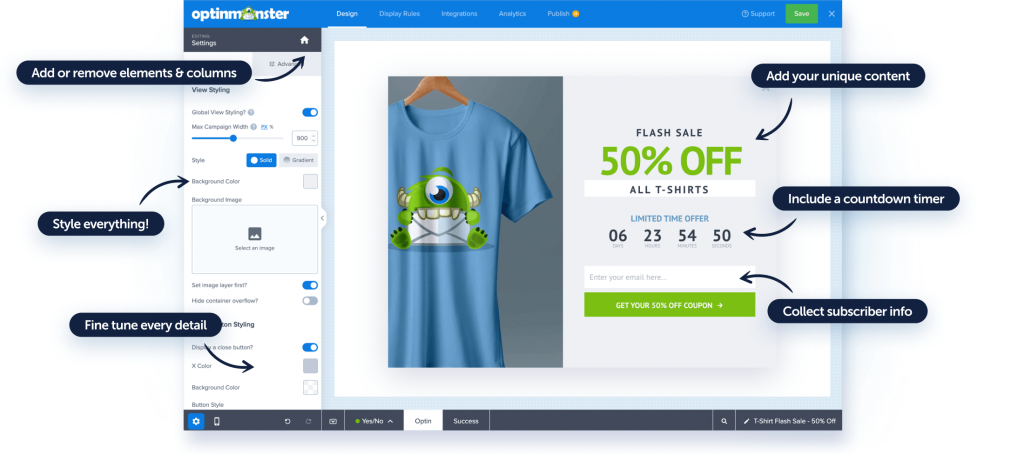
It supports exit-intent popups, opt-in forms, post footers, embedded forms, and floating bars, so I never felt limited to a single display type. I also liked how I could target campaigns by page, category, user type, or referral source, while built-in A/B testing made optimization easier.
The analytics provide a clear view of conversions and impressions without requiring a third-party tool. My biggest drawback is pricing. Exit intent and UTM tracking require the Pro plan, while Spin-to-Win gamification is only available on the Growth tier. That makes it a tougher choice if you need those features on a smaller budget.
Pros:
- Multiple popup formats, including exit-intent, floating bars, and embedded forms, let you run diverse campaigns from one platform.
- Page, category, and referral-source targeting helps deliver relevant offers to the right audience with minimal setup.
- Built-in A/B testing on all plans makes campaign optimization accessible to everyone.
- Conversion analytics tracks impressions, clicks, and CTR in a single dashboard for easy reporting.
- Integrates with major email marketing and CRM platforms, ensuring leads flow directly into your existing workflows.
Cons:
- Exit intent and advanced integrations like Klaviyo are gated behind the Pro plan at $89.99/month
- No forever-free plan
How OptinMonster Compares With OptiMonk: OptinMonster offers broader popup formats and a more mature feature set than OptiMonk. The trade-off is pricing: key features require higher tiers on both platforms, but OptinMonster’s ecosystem of integrations and campaign types gives it an edge for teams running complex multi-channel funnels.
User Rating: 4.2/5 (Capterra)
Pricing: Paid plan starts at $7/month
3. Thrive Leads: Best for Maximizing Lead Generation on WordPress
A WordPress developer I work with introduced me to Thrive Leads after I complained about a bloated plugin slowing down client sites. Once I got inside, the reporting depth alone justified the switch. I could see conversion rates, impressions, and list growth broken down per form, per group, and per campaign, a level of granularity I had not found anywhere else at this price point.
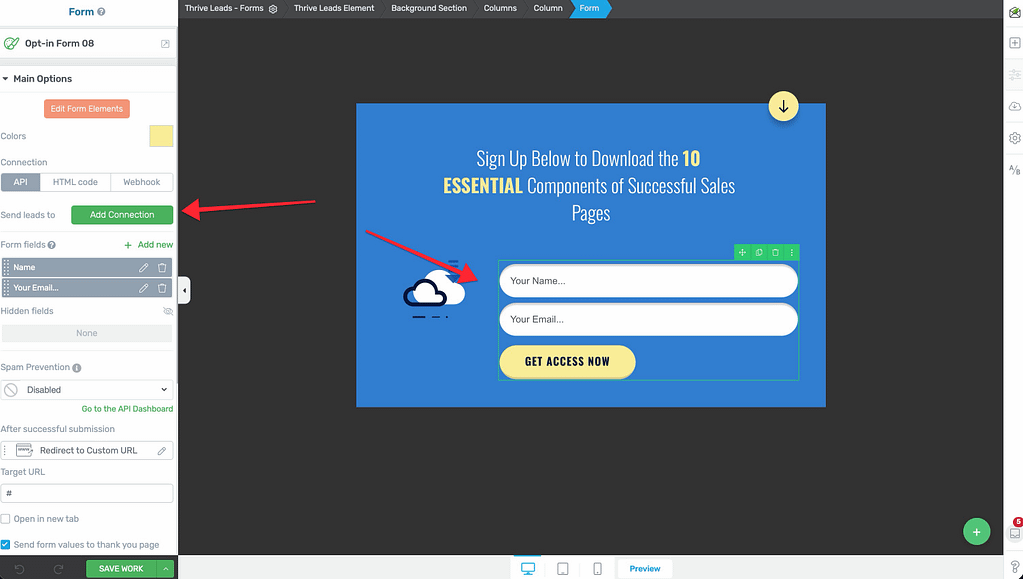
What genuinely surprised me was the subscriber-aware targeting, which lets you show completely different popups to people already on your list and solves one of email marketing’s most persistent blind spots. For WordPress users, the one-time yearly cost makes far more financial sense than stacking monthly SaaS fees.
Pros:
- Unlimited A/B testing lets you optimize headlines, CTAs, colors, and more without test limits.
- Smart targeting hides opt-in forms from existing subscribers, creating a better user experience.
- Content Locking gates premium content behind sign-ups, making it ideal for growing your email list.
- Asset Delivery automatically sends lead magnets after signup, keeping your funnel fully automated.
- Fast-loading, responsive forms ensure a smooth experience across desktop and mobile devices.
Cons:
- The reporting system can be slow and buggy at scale
- Some templates look dated compared to newer tools
How Thrive Leads Compares With OptiMonk: Thrive Leads wins on A/B testing depth and smart subscriber targeting. OptiMonk has broader trigger types, but Thrive Leads is a one-time yearly purchase that makes more financial sense for WordPress users who do not want monthly SaaS fees adding up.
User Rating: 5/5 (Based on 2 Capterra reviews)
Pricing: Paid plan starts at $299/year
4. ConvertBox: Best for Personalized On-Site Messages at Scale
A SaaS founder I met at a marketing conference had switched from OptinMonster to ConvertBox six months earlier and told me the personalization capabilities changed how he thought about on-site engagement entirely. His team was running campaigns without routing anything through a developer, which, for a lean growth team, is the kind of operational shift that actually compounds over time.
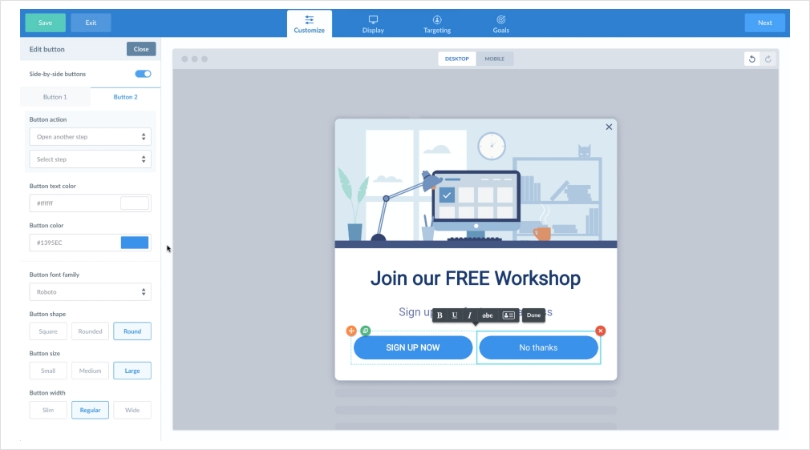
The targeting rules let you segment by funnel stage, referral source, previous behavior, and custom data fields simultaneously, giving you message-to-segment precision that most popup tools simply don’t offer at this price point. The drag-and-drop editor felt intuitive from the first session, and the split testing dashboard showed variant performance clearly without burying the data.
For SaaS companies running nurture sequences, that level of precision is what moves conversion rates from 2% to 7%. The lifetime pricing model means you pay once and own it, which changes the ROI calculation entirely.
Pros:
- Advanced segmentation by funnel stage, referral source, and custom fields enables highly targeted messaging without developer support.
- A drag-and-drop editor with live preview helps marketers build and launch campaigns quickly on their own.
- Detailed split testing reveals top-performing variants with data-backed confidence.
- Real-time campaign and segment analytics provide clear insights for optimization.
- A lifetime pricing model removes recurring fees and lowers long-term ownership costs.
Cons:
- No built-in CRM, so lead storage and management require an integration
- Fewer templates than most competitors
How ConvertBox Compares With OptiMonk: ConvertBox’s personalization is more sophisticated than OptiMonk’s equivalent features, and the lifetime deal makes total cost of ownership significantly lower. OptiMonk has more trigger types, but ConvertBox wins on ease of campaign management and long-term value.
Pricing: Starts at $495 (one-time lifetime)
5. Wisepops: Best for E-commerce Brands That Won’t Compromise on Design Quality
I keep recommending Wisepops to e-commerce clients who care about how their popups actually look, because cheap-looking campaigns actively undermine brand trust, and most tools in this category don’t take that seriously enough.
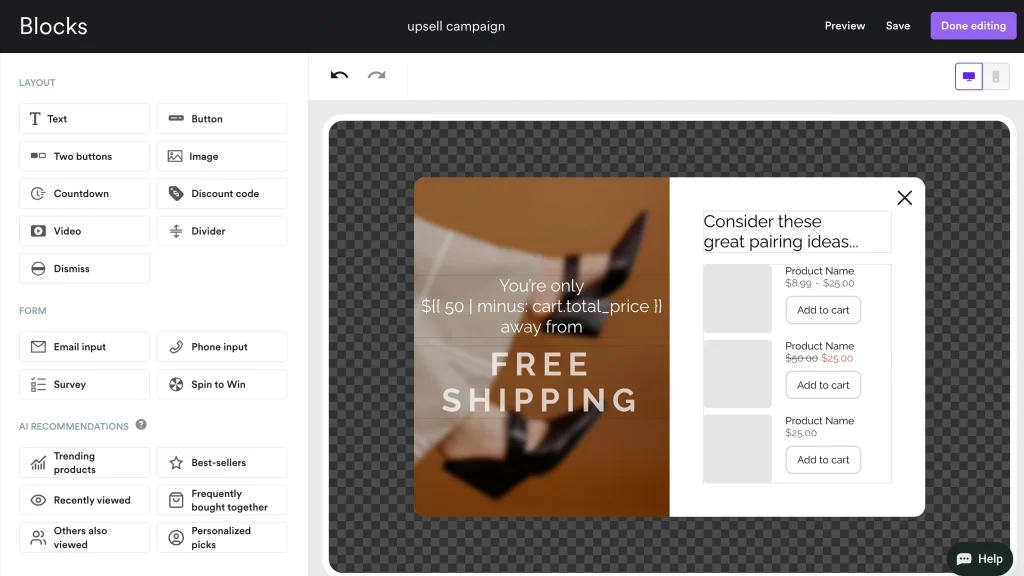
The design quality is noticeably higher than anything else I’ve tested at this level, and the native Klaviyo and Shopify integration is tight enough that segmented email flows connect without friction. It also supports custom website builds beyond Shopify storefronts, making it more flexible than several direct competitors.
Targeting covers browsing behavior, traffic source, and cart status, and custom fields let you capture names, phone numbers, emails, and preferences all within the same popup without added complexity. If you’re running a DTC brand where every touchpoint reflects the brand, Wisepops earns its price point.
Pros:
- Conversion-focused templates help your popups blend naturally with your brand.
- Native Klaviyo and Shopify integrations keep segmented email flows running smoothly.
- An intuitive drag-and-drop editor enables non-designers to launch campaigns with ease.
- Built-in A/B testing helps you continuously improve campaign performance.
- Targeting based on traffic source, cart status, and behavior delivers the right offer at the right time.
Cons:
- Heavily focused on email-driven campaigns, which may feel limiting for non-email use cases
- Higher entry price than most alternatives on this list
How Wisepops Compares With OptiMonk: For e-commerce specifically, Wisepops gives you better design, tighter Klaviyo integration, and cleaner Shopify compatibility than OptiMonk. OptiMonk is more versatile across non-ecommerce use cases, but for DTC brands, Wisepops is the stronger choice.
User Rating: 4.9/5 (Capterra)
Pricing: Paid plans start at €499
6. Privy: Best for Shopify and Email Marketing Teams That Want an All-in-One
Privy is primarily an email and SMS marketing platform that happens to have genuinely good popup functionality built in, and that combination is what makes it worth including here. I’ve seen it work really well for e-commerce brands that want their list building and email campaigns managed in the same place rather than stitching two tools together.
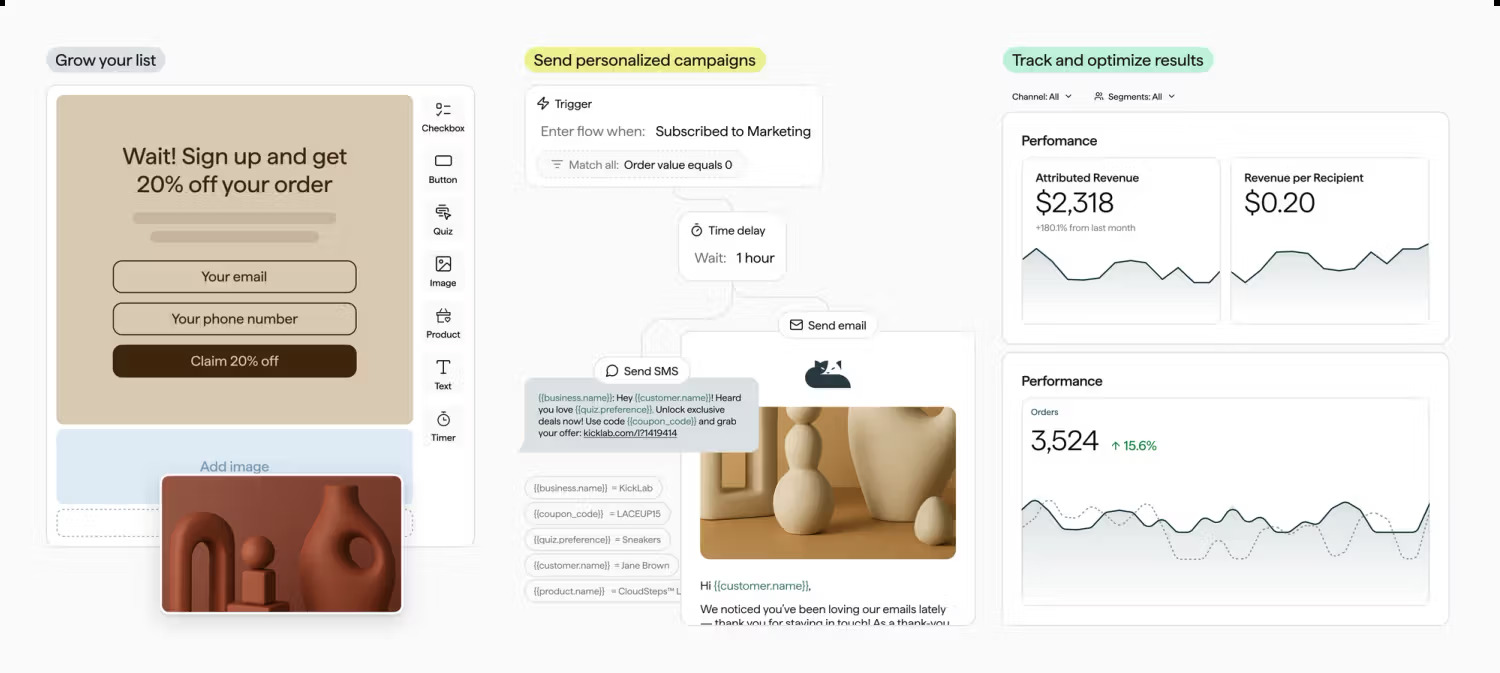
The targeting options are wide-ranging and straightforward, so personalizing campaigns doesn’t require complex rule configurations. For Shopify stores running campaigns around promotions, new product launches, or cart abandonment, the platform integration is clean and fast to set up.
The drag-and-drop designer covers modals, banners, bars, and flyouts, and A/B testing is included at no extra cost. If you’re tired of paying separately for your popup tool and your email platform, Privy solves that with a single subscription.
Pros:
- Built-in email and SMS marketing lets you manage list growth and campaigns from a single platform.
- A drag-and-drop popup builder supports modals, banners, bars, and flyouts without extra tools.
- Flexible targeting personalizes campaigns based on behavior, cart status, and page activity.
- Ready-made templates help you launch campaigns quickly without starting from scratch.
- Native Shopify integration keeps popups, triggers, and email flows connected seamlessly.
Cons:
- More limited popup customization compared to dedicated popup tools
- Custom plans can get expensive at scale
How Privy Compares With OptiMonk: Privy bundles email, SMS, and popups into one subscription, which OptiMonk doesn’t. For Shopify stores that want everything in one place, Privy simplifies the stack. OptiMonk offers deeper popup targeting options, but Privy wins on all-in-one value for e-commerce email marketers.
User Rating: 5/5 (Based on 6 Capterra reviews)
Pricing: Paid plans start at $299/month
7. Getsitecontrol: Best for Budget-Conscious Teams Who Need Smart Popups Without the Upgrade Tax
Getsitecontrol kept coming up in Reddit threads about OptiMonk alternatives, specifically in communities where pricing was the loudest complaint, and after testing it, I understood why. Full A/B split testing is available on every plan, no upgrade wall required.
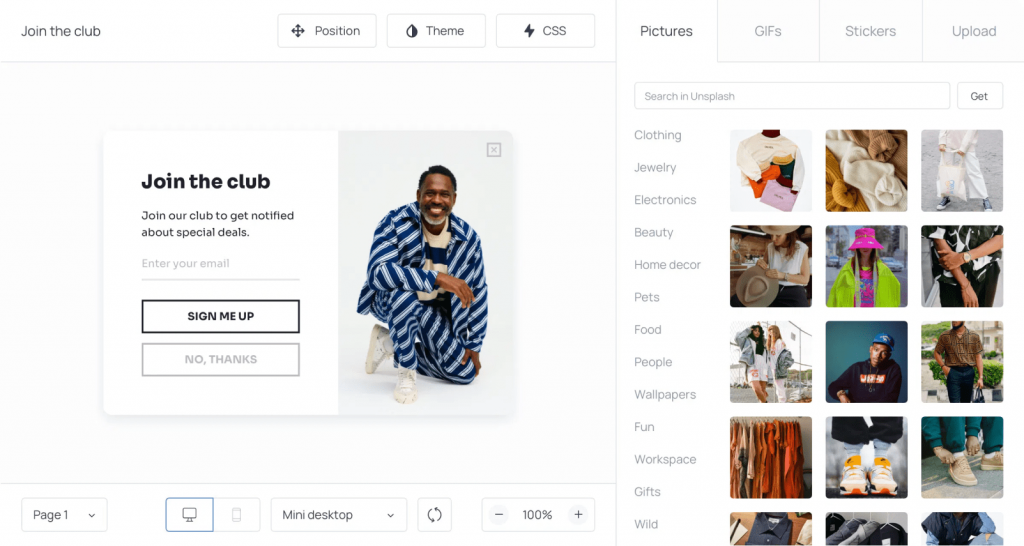
Display triggers cover time on page, scroll depth, and exit intent without needing a premium tier to unlock them. I was impressed by how much comes in one clean dashboard: modals, slide-ins, floating bars, sticky headers, and full-screen overlays, all manageable by a solo marketer who signs up and launches a campaign the same afternoon.
If your main frustration with OptiMonk is paying extra for features that should come standard, GetSiteControl is one of the most honest value propositions on this list.
Pros:
- Full A/B testing is available on all plans, helping you optimize campaigns from day one.
- Exit-intent, scroll-depth, and time-based triggers are included even at the entry level.
- Multiple popup formats, including modals, slide-ins, bars, and overlays, are managed from one dashboard.
- Affordable pricing scales with your business, without forcing enterprise-level costs early on.
- A clean, user-friendly dashboard makes campaign management easy for small teams.
Cons:
- No onboarding or training resources for new users
- Unlimited widget deployment can create dashboard clutter if campaigns aren’t organized well
How Getsitecontrol Compares With OptiMonk: Getsitecontrol covers the core use cases OptiMonk is used for: email capture, exit intent, and targeted offers. It lacks the same breadth of targeting rules, but for teams where budget is the primary constraint, the value gap is hard to ignore.
User Rating: 4.7/5 (Capterra)
Pricing: Paid plans start at $19/month
8. Bloom: Best for WordPress Users Who Want Visually Polished Opt-in Forms
Bloom is a WordPress-exclusive email opt-in plugin from Elegant Themes that stands out because the team invested heavily in template design before anything else, and it shows. The forms integrate into websites naturally, looking like they belong there rather than sitting on top of the page.
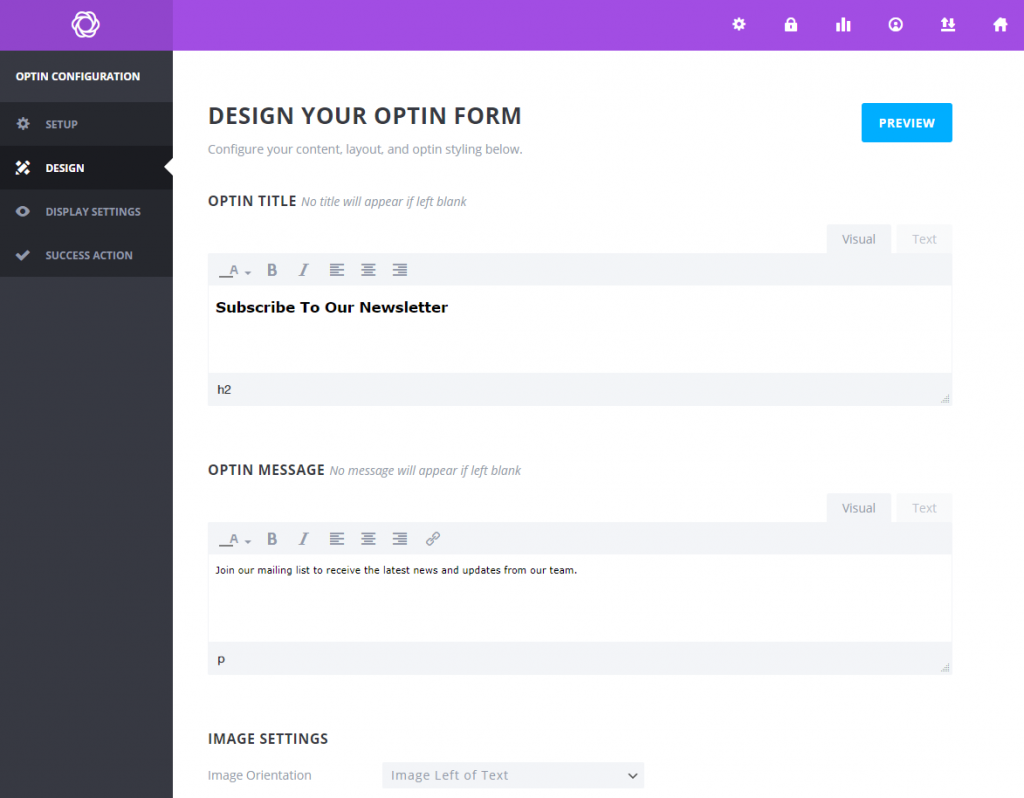
I’d recommend it to any WordPress publisher or content marketer who wants opt-in forms that don’t look like they came from a generic popup builder. It offers six different display types and more than 500 pre-made templates covering a wide range of targeting needs.
Direct integrations with 16 major email marketing platforms mean your subscriber data flows cleanly without an extra layer in between. A/B testing and detailed conversion and list growth statistics round out the feature set for teams that want to optimize without switching tools.
Pros:
- 500+ professionally designed templates help your opt-in forms blend seamlessly with your brand.
- Six display formats provide flexibility across pages, posts, and sidebars from a single tool.
- Native integrations with 16 email marketing platforms send subscriber data directly to your ESP.
- Built-in A/B testing helps improve conversions without leaving the WordPress dashboard.
- Detailed conversion and list growth analytics make it easy to measure and scale lead generation efforts.
Cons:
- WordPress-only, so it doesn’t work for non-WordPress sites
- Exit intent targeting is less robust than dedicated popup platforms
How Bloom Compares With OptiMonk: Bloom wins on design quality and WordPress-native experience. OptiMonk offers broader trigger types and works across all platforms. For WordPress content sites where aesthetics matter and the audience is opt-in-first, Bloom is the cleaner fit.
User Rating: 4.3/5 (Capterra)
Pricing: Paid plans start at $7/month
9. Sleeknote: Best for Non-Intrusive Popups That Feel Native to Your Site
I came across Sleeknote through a CRO forum where multiple practitioners working with high-traffic ecommerce sites kept recommending it, and their common thread was that it doesn’t feel like a traditional popup tool: it feels like a native part of the site.
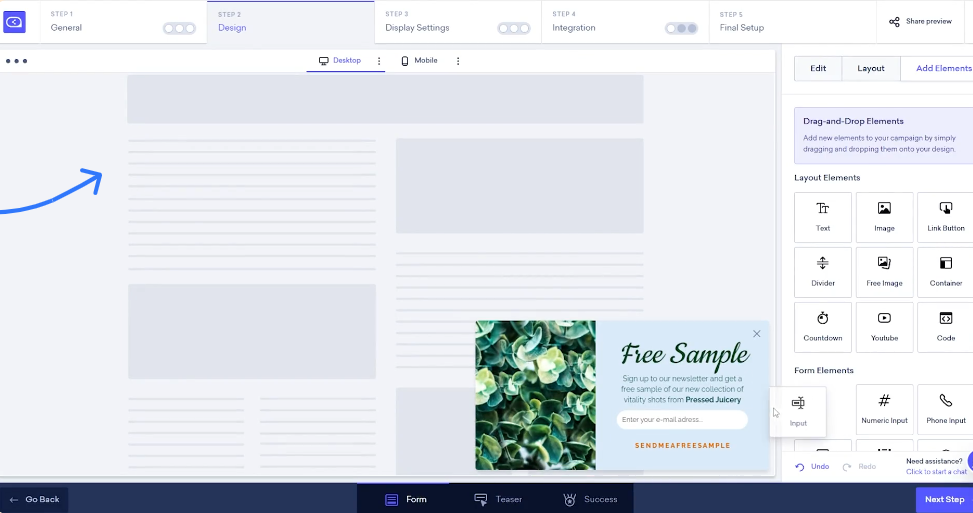
That’s intentional, because Sleeknote defaults toward slide-ins and embedded forms rather than full-screen takeovers, and the drag-and-drop editor makes building those feel effortless. What impressed me most was the dedicated mobile editor, which treats mobile as a first-class design experience rather than a resized version of the desktop campaign.
For brands where user experience and aesthetic consistency are non-negotiable, and where annoying popups are a real brand risk, Sleeknote gives you conversion-focused campaigns that don’t feel like interruptions.
Pros:
- Non-intrusive slide-ins help capture leads without disrupting the user experience.
- A dedicated mobile editor makes it easy to create mobile-first campaigns that perform well on any device.
- Advanced triggers, including time on page, scroll depth, and behavior, help engage visitors at the right moment.
- Real-time analytics provide detailed campaign insights for optimization and stakeholder reporting.
- Integrations with HubSpot, Campaign Monitor, Drip, and other major platforms keep leads flowing into your marketing stack.
Cons:
- Some popup types have mobile optimization inconsistencies despite the mobile editor
- Compatibility issues reported with certain browsers and plugins
How Sleeknote Compares With OptiMonk: Sleeknote wins on design quality, brand consistency, and mobile-first thinking. OptiMonk has more trigger types at lower price points. For brands where user experience and aesthetics are non-negotiable, Sleeknote justifies its premium.
User Rating: 4.8/5 (Capterra)
Pricing: Paid plans start at €49/month
10. Poptin: Best for Getting Started With Popups Quickly and Inexpensively
A startup founder I know switched to Poptin after getting priced out of OptinMonster during early growth, and his take was that it covers 80% of what he needed at roughly 20% of the cost, which for a bootstrapped operation is math that’s genuinely hard to argue with.
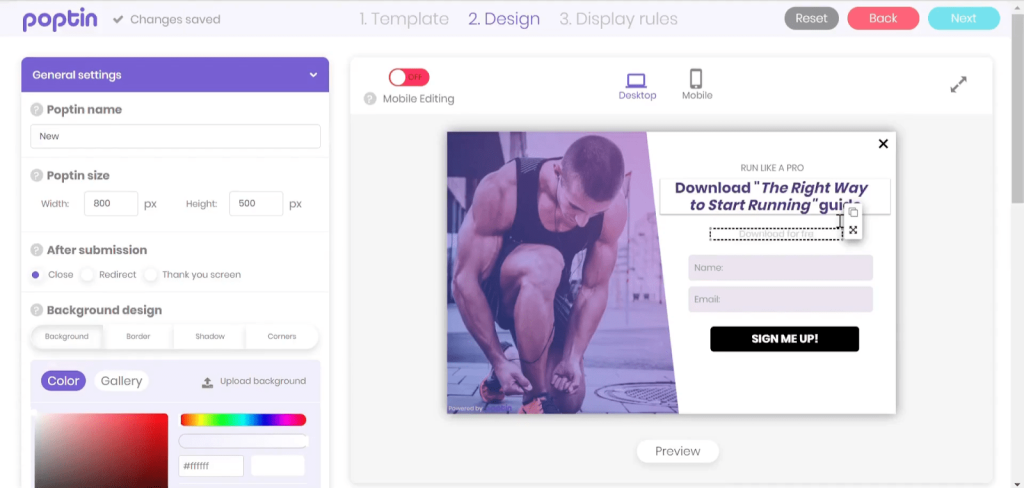
The drag-and-drop editor handles classic modals, countdown popups, full-screen overlays, and bars cleanly without a steep learning curve. The feature that stuck with me was the embedded lead form that captures emails directly inside the popup without redirecting the visitor to another page.
That one detail meaningfully reduces drop-off in the conversion flow. Precise cursor tracking ensures exit intent fires at exactly the right moment rather than too early or too late, which is a common frustration I’ve heard about cheaper popup tools.
Pros:
- Embedded lead forms capture emails inside the popup, so visitors can opt in without leaving the page.
- Precise cursor tracking triggers exit intent at the right moment, avoiding early or annoying popups.
- A/B testing and targeting support standard optimization needs without requiring an advanced plan.
- Referral-source targeting shows tailored offers to visitors from different traffic channels.
- A clean drag-and-drop editor helps you launch multiple popup types in under 30 minutes.
Cons:
- Analytics are limited compared to more mature tools
- Smaller template selection than some competitors
How Poptin Compares With OptiMonk: Poptin is the budget-friendly alternative with solid core functionality. OptiMonk has a more mature feature set and deeper analytics, but Poptin’s value at entry-level pricing makes it the right starting point for early-stage businesses that cannot justify OptiMonk’s higher tiers yet.
User Rating: 4.8/5 (Capterra)
Pricing: Paid plans start at $25/month
How I Chose These OptiMonk Alternatives
Picking tools for a list like this is not something I take lightly. I followed a systematic approach to make sure every recommendation is fair, grounded, and actually useful for someone making a real purchasing decision.
- User Reviews and Ratings: I started with verified feedback on Capterra, looking for patterns across reviews rather than isolated opinions. If multiple users flagged the same limitation or praised the same feature consistently, that shaped the assessment.
- Essential Features and Functionality: I focused on what actually drives conversion performance: trigger types, targeting depth, template quality, mobile support, and whether the tool delivers on the use case it claims to handle. A tool that lists exit intent as a feature but only supports basic desktop mouse-out detection did not rank as high, regardless of interface polish.
- Ease of Use: If launching your first campaign takes more than 30 minutes, that friction compounds every time you create or adjust a campaign. Tools with clear campaign flows and minimal technical requirements naturally ranked higher. Non-technical marketers should be able to operate the tool independently.
- Customer Support: Plugin conflicts, caching issues, and integration failures are common across popup tools. I looked at support availability, response times cited in reviews, and how well teams assist during setup and troubleshooting, not just after problems arise.
- Value for Money: I evaluated value based on what you realistically get at the pricing tier most businesses would actually use, not just the cheapest entry plan. Free plans and trials were assessed on how useful they are before the upgrade pressure kicks in.
- Personal Experience and Expert Opinions: I factored in firsthand observations and patterns from marketers running real conversion campaigns. If a tool consistently created friction or consistently impressed experienced users, that showed up in the final ranking.
My Top 3 OptiMonk Alternatives
After testing all ten tools and comparing them against each other, three consistently came out on top for different reasons. Which one fits you depends entirely on where OptiMonk was letting you down.
1. Picreel
Picreel is my top overall pick, and the reason is straightforward: it solves the broadest set of problems OptiMonk users actually face. The exit intent triggers work across desktop and mobile, the AI Popup Builder gets you live in under 15 minutes, and Advanced Targeting handles segmentation by location, referral source, UTM parameters, and new versus returning visitor without any technical complexity.
2. Thrive Leads
Thrive Leads earns its place as the top WordPress-specific option because of what it does with A/B testing and subscriber-aware targeting. If you’re running a content site, a WooCommerce store, or any WordPress-based operation where you want to grow a list without irritating people already on it, Thrive Leads handles that better than anything else I tested. The one-time yearly pricing means you’re not adding another recurring SaaS fee to a stack that’s already expensive.
3. ConvertBox
ConvertBox is the right choice if personalization and long-term cost are your two biggest priorities. The targeting rules let you segment by funnel stage, referral source, previous behavior, and custom data fields simultaneously, and for SaaS companies running nurture sequences, that precision is what actually moves conversion rates. The one-time lifetime pricing means you pay once and own it, which changes the ROI calculation entirely compared to a monthly SaaS fee that compounds year over year.
FREE. All Features. FOREVER!
Try our Forever FREE account with all premium features!
Which OptiMonk Alternative Is Right for Your Use Case?
Not every OptiMonk alternative is built for the same audience, so here’s a quick breakdown of which tool I recommend based on your specific use case.
| Use Case | Recommended Tool(s) | Why |
| Shopify & Ecommerce Stores | Wisepops, Privy | Wisepops excels in design quality and Klaviyo integration, while Privy combines popups, email, and SMS in one platform. |
| SaaS Companies | ConvertBox, Picreel | ConvertBox offers advanced personalization by funnel stage, while Picreel provides broader integrations and flexibility. |
| Agencies Managing Multiple Sites | Picreel, ConvertBox | Both support multi-site deployment without restrictive domain limits. |
| WordPress Websites | Thrive Leads, Bloom, Picreel | Thrive Leads is best for list growth, Bloom for polished opt-in forms, and Picreel for a cloud-based solution that avoids plugin conflicts. |
| Budget-Conscious Teams | Getsitecontrol, Poptin | Getsitecontrol delivers strong value for the price, while Poptin is ideal for startups and early-stage businesses. |
| Simple Email List Growth | Picreel | Includes exit intent, behavioral targeting, and native integrations with minimal setup required. |
How to Switch From OptiMonk Without Losing Active Campaigns
If you’re mid-campaign and worried about losing leads during a transition, here’s the approach I’d take.
- Run both tools in parallel for 10 to 14 days: Export your active campaign list from OptiMonk and recreate your highest-performing ones in your new tool first. Confirm that conversion tracking is firing correctly in the new setup before switching off OptiMonk.
- Rebuild high-performing campaigns first: Don’t recreate everything at once. Identify your top three campaigns by conversion rate and migrate those. Lower-performing campaigns can be rebuilt or improved in the new tool from scratch.
- Swap the script tag last: Most cloud-hosted tools like Picreel work with a single script tag. Once your campaigns are live and tracking correctly, remove the OptiMonk script and confirm your new setup is running cleanly.
- Connect your email platform immediately: Don’t wait until after launch to set up integrations. Run an integration test before you remove OptiMonk to make sure leads are flowing into Klaviyo, Mailchimp, or HubSpot correctly.
- Give it two weeks of data before drawing conclusions: A clean switch followed by two weeks of campaign data will tell you everything you need to know about whether the new tool is working. Don’t optimize too early.
Stop Paying More for Tools That Deliver Less
Choosing the top alternatives to OptiMonk ultimately comes down to your goals, budget, and marketing stack. Some tools excel at e-commerce personalization, others focus on WordPress lead generation, while a few prioritize affordability or advanced targeting.
If you’re looking for the most balanced option, Picreel stands out because it combines AI-powered campaign creation, exit-intent technology, advanced targeting, and extensive integrations without forcing you into expensive plans just to access core features.
It works equally well for SaaS companies, ecommerce brands, agencies, and content-driven websites, making it a flexible long-term choice. Start by identifying the biggest limitation you’re facing with OptiMonk, shortlist two or three alternatives that match your use case, and test them side by side. Most offer free plans or trials, making it easy to compare performance before committing.
Frequently Asked Questions
What is the best free OptiMonk alternative?
Picreel offers a forever-free plan for up to 5,000 visitors that includes real exit intent, behavioral targeting, and direct integrations with email marketing tools. Poptin and Privy also offer free plans, though with more limited targeting options compared to Picreel.
Why are marketers switching from OptiMonk in 2026?
The most common reasons are pageview-based pricing that scales unpredictably, key features like exit intent and UTM targeting being locked behind higher tiers, an ecommerce-heavy feature set that doesn't map well to SaaS or agency use cases, and site/domain restrictions on entry plans.
Which OptiMonk alternative works best for SaaS companies?
ConvertBox is the strongest fit for SaaS teams that need funnel-stage personalization and long-term cost efficiency. Picreel is the better option if you also need broad integration support with CRM and marketing automation tools like HubSpot and Salesforce.
Which popup tool is best for Shopify stores?
Wisepops delivers the best combination of design quality and native Shopify plus Klaviyo integration for DTC brands. Privy is a strong second if you want email and SMS marketing bundled with your popup tool.
Can popup tools hurt my Google rankings?
They can if implemented poorly. Popups that block primary content on mobile or slow Core Web Vitals scores can trigger Google penalties. Cloud-hosted tools like Picreel load scripts externally and avoid adding server load. Always test page speed and mobile experience after installing any popup tool.
What is the difference between exit intent and time-delay popups?
Exit intent fires based on behavioral signals, such as cursor movement toward the browser close button on desktop or scroll-up behavior on mobile. Time-delay fires after a set number of seconds regardless of behavior. Exit intent typically converts better because it reaches visitors at the highest-intent moment.
Which OptiMonk alternative is best for agencies managing multiple client sites?
Picreel and ConvertBox both handle multi-site deployment without domain-based restrictions. Picreel's centralized dashboard and broad integration ecosystem make it easier to manage campaigns across client properties without needing separate accounts per client.
Do popup tools work for lead generation on non-ecommerce sites?
Yes. Tools like Picreel, ConvertBox, and Getsitecontrol are well-suited for SaaS, content sites, and B2B lead generation. OptiMonk's e-commerce focus is actually one of the reasons SaaS teams look for alternatives.
How do I choose between pageview-based and visitor-based pricing?
Pageview-based pricing charges for every page a visitor loads, even if no campaign fires. Visitor-based or flat pricing is more predictable for growing sites. If you have high traffic with low monetization, pageview-based models can become expensive quickly.
What popup tool has the best Klaviyo integration?
Picreel integrates natively with Klaviyo without requiring Zapier, and so does Wisepops. Both support segmented list targeting so leads flow directly into the right Klaviyo flows after opt-in.
FREE. All Features. FOREVER!
Try our Forever FREE account with all premium features!

 We'd love your feedback!
What did you like & how can we make it even better?
 Thanks for your feedback!
 Ask Your Question
Have a question? Get expert help to make your decision easier.