
If you’re driving traffic but not converting visitors into subscribers or buyers, you’re not alone. Most businesses rely on the usual “Get 10% off” popup and see little impact.
The issue isn’t the offer. It’s the format. Static popups have become easy to ignore, and users scroll past them without a second thought.
Data backs this up. According to Omnisend (2026), the average popup conversion rate ranges between 2% and 4%, which means most of your traffic leaves without engaging.
This is where spin-the-wheel popups shift the equation. They turn a basic offer into an interactive experience that naturally pulls users in. Instead of interrupting, they invite participation.
The outcome is straightforward. Better engagement, more email captures, and improved conversion from the traffic you already have.
In this guide, I’ll walk you through how to make this work effectively for your business.
Here’s what we’ll cover:
- Spin-the-wheel popups are gamified overlays where visitors enter their email to spin for a prize. According to Claspo (2025), spin-the-wheel popups convert at an average rate of 9.25%, compared to 3.53% for standard popups.
- The best results come from exit-intent or time-delay triggers (15–20 seconds), not page-load triggers.
- Use a tiered prize structure: 60–70% low-tier prizes, 15–20% mid-tier, and 5–10% high-tier to keep excitement high without hurting margins.
- Always issue single-use coupon codes, send an automated post-spin email within 60 seconds, and connect your wheel to your email platform for follow-up sequences.
- Tools like Picreel let you build, target, and integrate spin wheels across multiple sites without writing any code.
Why Are Your Current Popups Not Converting?
Before we look at spin wheels, it helps to understand why standard popups stop working. The problem isn’t popups. It’s how they’ve been used for years.
Users today are overloaded and have learned to ignore them:
- Most people ignore banner-like ads completely
- Even well-optimized campaigns struggle unless they go beyond basic formats
So when your popup looks like every other “10% off” form, it’s not competing for attention. It’s being skipped.
Here’s what’s broken:
- Asking for an email before showing any value pushes visitors away
- Predictable offers like fixed discounts fail to create interest
- Repetitive designs make users close popups instantly
- Passive forms don’t give visitors a reason to interact
What Is a Spin the Wheel Popup & Why Is It Important?
A spin-the-wheel popup is an interactive website popup where visitors enter their email to spin a wheel and win a reward like a discount, free shipping, or a freebie.
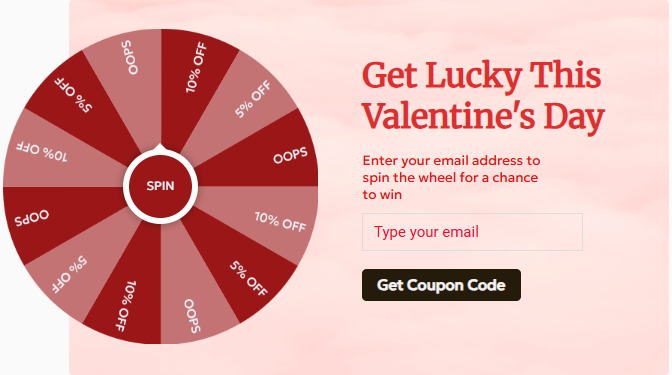
Here’s how it works. The visitor signs up, clicks spin, and instantly gets a prize along with a coupon code. While it feels random, you control the outcomes and probabilities behind the scenes.
What makes it different is the experience. Instead of a plain form, it adds anticipation and excitement. People are naturally more likely to engage when there’s a chance to win something.
Businesses use spin-the-wheel popups to:
- Capture email subscribers and boost conversions
- Reduce cart abandonment with instant incentives
- Promote trials, offers, or gated content
- Segment users based on their choices
It’s the same goal as a regular popup, just done in a way people actually interact with.
What Discount Should You Offer in a Spin Wheel Popup?
This is where most store owners make their most expensive mistake. They load the wheel with exciting prizes because they want the spin the lucky wheel popup to look compelling. Then every third visitor wins 25% off, and margins quietly disappear.
The solution is a tiered prize structure that makes every spin feel rewarding without exposing you to unsustainable discount costs.
Recommended prize structure:
| Tier | Prize Examples | Recommended % of Wheel |
|---|---|---|
| Low-tier | 5% off, free digital download, 50 loyalty points | 60–70% |
| Mid-tier | 10–15% off, free shipping, $5 store credit | 15–20% |
| High-tier | 20–25% off, free product, BOGO | 5–10% |
| Near-miss (optional) | "Spin again" segment | 5% |
With this setup, every visitor wins something of perceived value. The low-tier prizes protect your margins while still feeling like a reward. The rare high-tier prizes create genuine excitement without becoming a constant cost center.
Two important design rules here:
- Never put a prize on the wheel you aren’t prepared to honor. If visitors feel like the high-value segments never actually land, trust in your brand takes a hit. Either remove prizes you don’t intend to award or set their probability low enough that winning feels genuinely rare.
- Match the prize to the visitor’s stage. A first-time visitor who has never seen your product responds differently to “free shipping” than a cart abandoner does. A returning visitor who browsed products three times but never bought needs a stronger reason to act. Adjust prize structures by audience segment.
For non-ecommerce brands, prizes can be entirely non-monetary. SaaS companies offer extended trial periods. Publishers offer premium content downloads. Lead generation businesses offer exclusive audits or consultations. The gamification mechanic works regardless of the prize category, as long as the reward is meaningful to your specific audience.
How Do You Build a High-Converting Spin the Wheel Popup?
Building a spin wheel that actually converts isn’t complicated, but there’s a specific sequence that separates high-performing implementations from ones that collect burner emails and disappear.
Here’s the full process:
Step 1: Define Your Conversion Goal
Before you touch any template, decide what you’re trying to achieve with this specific spin the lucky wheel popup. Your goal determines every other decision: the prize structure, the trigger, the targeting rules, and the follow-up sequence.
| Quick AI Prompt to Choose Your Goal:“Based on my website type: ________ Traffic source (e.g., organic, ads, social): ________ Current challenge (low conversions, cart abandonment, low engagement): ________What should be the primary goal of my spin-the-wheel popup and why?” |
Common goals and how they shape the setup:
- Email list growth: Target new visitors, use a 15–20 second time delay, offer a mix of low and mid-tier prizes, and connect to your welcome email sequence.
- Cart abandonment recovery: Target visitors with items in their cart on cart or checkout pages, use an exit-intent popup, focus prizes on free shipping and percentage off cart total.
- Re-engagement of returning visitors: Show a different wheel to visitors who’ve been to the site before but haven’t converted, use a “We saved your spin” angle with a slightly stronger offer.
- Seasonal campaign: Run during peak buying periods like Black Friday or end-of-season sales, align all prize segments and visual design to the campaign theme.
Step 2: Build Your Spin-the-Wheel Popup
Open Picreel or your preferred popup builder and create a new campaign. You don’t need any coding. Just choose how you want to build:
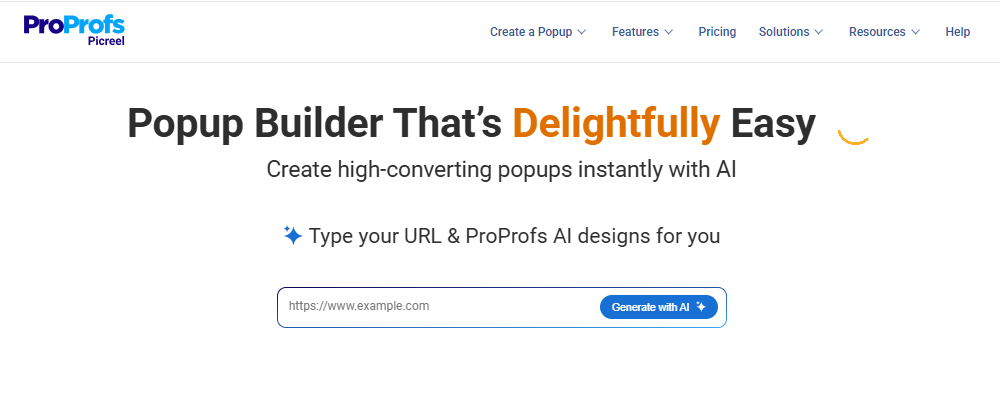
If you want speed, use an AI builder. Enter your website URL and goal, and it generates a spin-the-wheel popup with layout, copy, and CTA aligned to your objective.
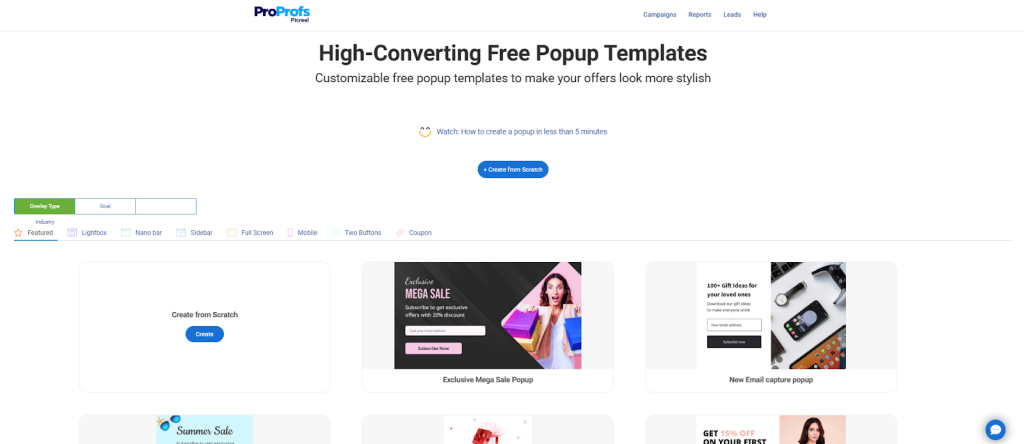
If you want more control, start with a popup template and customize it using a drag-and-drop editor.
Now focus on what actually improves conversions:
- Ask for email only on first touch. Extra fields reduce opt-ins
- Write a benefit-driven headline. “Spin to unlock your exclusive deal” works better than generic copy
- Use action-oriented CTA like “Spin Now” or “Try Your Luck”
- Show the reward clearly if you’re offering a lead magnet
| Headline writing prompt “My visitor is on [this page] and cares about [problem]. The reward I’m offering is [offer]. Write 3 benefit-driven, curiosity-based headlines.” |
Customize for Better Results
- Colors: Match your brand. A generic wheel feels low trust
- Fonts: Keep typography consistent with your site
- Prize labels: Short, clear, benefit-focused
- Segments: Use 5 to 8. Too few feels empty. Too many looks cluttered on mobile
- Copy style: Build anticipation, not explanation
Note: If you have EU visitors, enable GDPR consent, link your privacy policy, and keep the checkbox unchecked by default.
Step 3: Build Your Prize Structure
Using the tiered structure from the previous section:
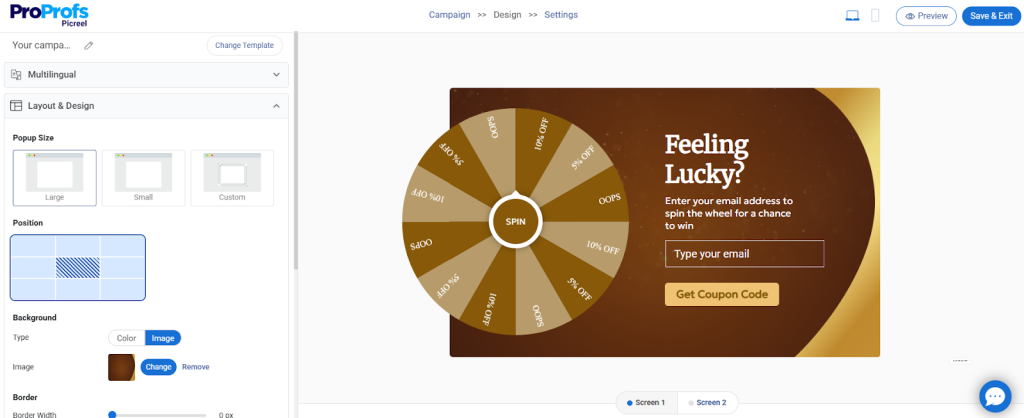
- Set 60–70% of wheel probability to low-tier prizes.
- Set 15–20% to mid-tier prizes.
- Set 5–10% to high-tier prizes.
- Configure unique, auto-generated coupon codes for each prize tier (not generic codes like “SPIN10” that get shared on coupon sites).
- Set coupon expiry to 48–72 hours to create urgency without being punishing.
Step 4: Set Your Trigger and Targeting Rules
Trigger options and when to use each:
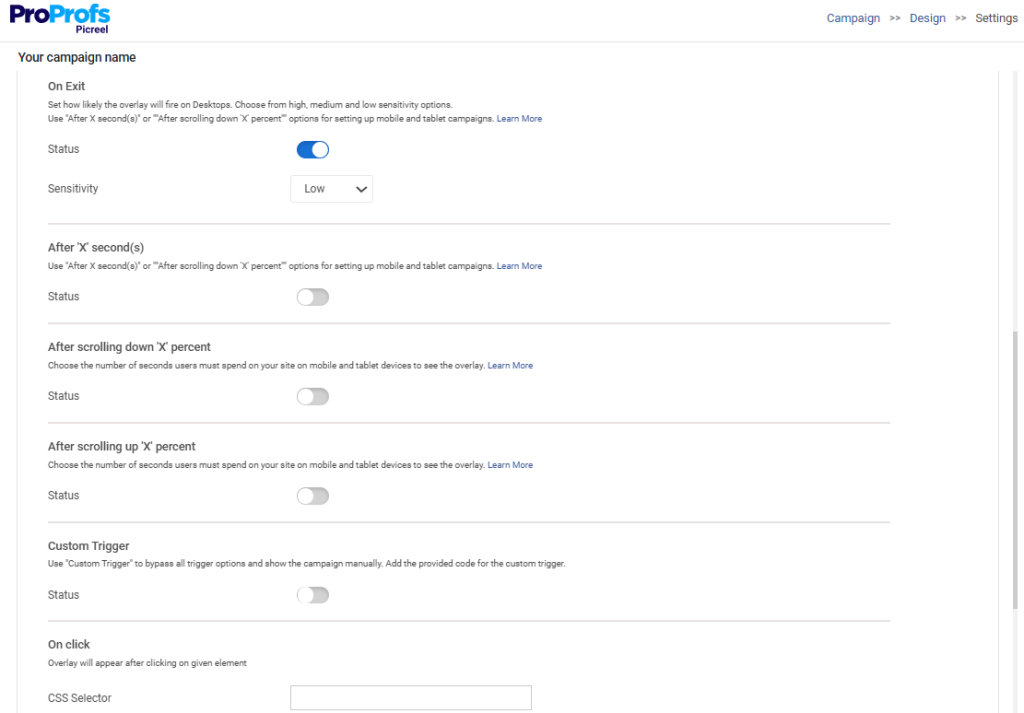
| Trigger | Best Use Case | Recommended Setting |
|---|---|---|
| Exit intent | Cart abandonment, new visitor recovery | Primary trigger for most campaigns |
| Time delay | New visitor email capture | 15–20 seconds after page load |
| Scroll depth | Engaged content readers | 40–60% scroll depth |
| Page-level | Cart/checkout abandonment | Specific URL match: /cart, /checkout |
Targeting rules to configure:
- New vs. returning visitors: Show the standard wheel to new visitors. Show a “We saved your spin” version to returning visitors who haven’t converted.
- Device type: Test mobile and desktop separately. Mobile often performs better with a slightly different layout.
- Traffic source: Visitors from paid ads have different expectations than organic visitors. Consider a stronger prize structure for cold traffic.
- Geography: If you don’t ship to certain countries, exclude them from the wheel. A coupon a visitor can’t use creates a frustrating experience.
- Frequency cap: Show the spin the lucky wheel popup a maximum of once per visitor per session, and not again for at least 7 days after dismissal.
Step 5: Connect Your Email Platform
This step is where most people leave money on the table. The email captured from the wheel is only as valuable as the sequence you send afterward.
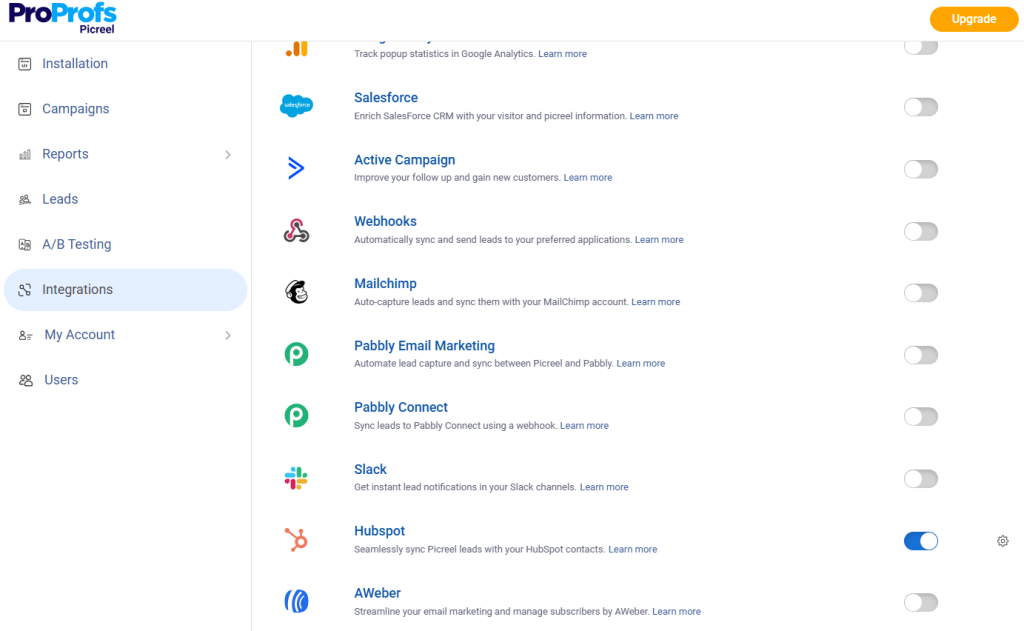
Integration setup:
- Connect your popup tool to your email platform, like BIGContacts, for custom workflows.
- Map the email field to your subscriber list.
- Tag new subscribers as “wheel-opt-in” or “spin-to-win” so you can segment and track them separately from other lead sources.
- Pass the prize won as a custom property if your platform supports it (e.g., “prize_won: free_shipping”) to trigger prize-specific follow-up flows.
The follow-up email sequence that converts:
- Email 1 (within 60 seconds of spin): Coupon code + welcome message + clear CTA to shop now. According to MailerLite (2025), the average email open rate is 43.46%, and since this email is triggered instantly while the subscriber is still engaged, it typically performs above that baseline.
- Email 2 (Day 2): Best-sellers or product recommendations based on the page they were on when the popup appeared.
- Email 3 (Day 4): Social proof, customer reviews, or brand story to build trust.
- Email 4 (Day 7, if no purchase): Coupon reminder with countdown to expiry.
Step 6: Run an A/B Test Before Committing
Do not permanently replace your current popup with a spin wheel based on an assumption. A/B test both simultaneously for 30 days. Measure:
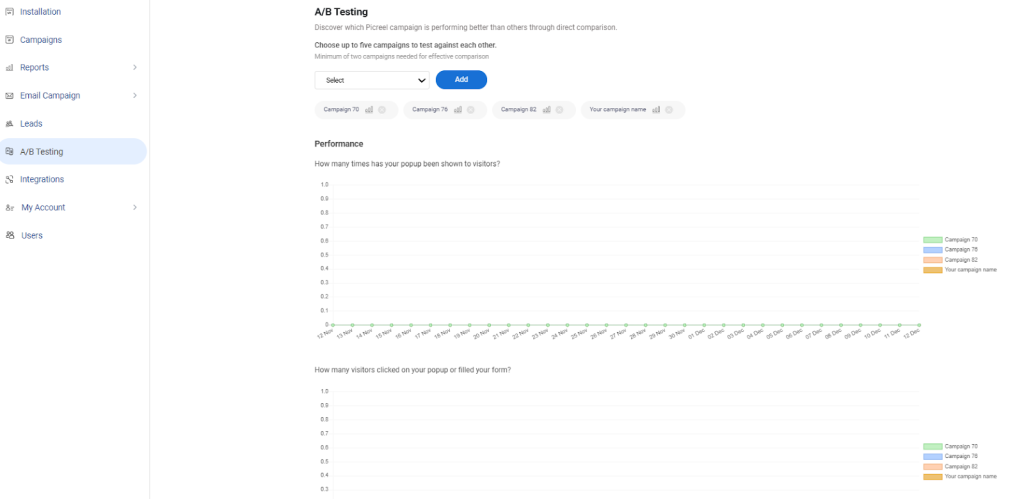
- Email capture rate (opt-ins divided by popup views)
- Coupon redemption rate (codes used divided by codes issued)
- Revenue per subscriber (revenue attributed to wheel opt-ins divided by the number of subscribers)
- List quality at 90 days (open rate and click rate of your welcome sequence)
Let the data determine whether the spin wheel stays. In most B2C ecommerce contexts, the wheel wins. In luxury, B2B, or professional services, the standard popup often performs better because brand perception matters more than gamification.
FREE. All Features. FOREVER!
Try our Forever FREE account with all premium features!
What Are the Best Practices for Spin-to-Win Coupon Popups?
Most spin wheels underperform not because the format is wrong, but because the execution is lazy. Getting four fundamentals right separates a wheel that quietly builds your list every day from one that annoys visitors and sends them straight to the back button.
1. Trigger It at the Right Moment, Not the Earliest One
The single most damaging decision I see is page-load triggering. A visitor who landed two seconds ago hasn’t seen a product, hasn’t felt any desire, and has zero reason to hand over their email. You’re essentially asking someone to commit before the first date.
| Page | Best Trigger | Why |
|---|---|---|
| Homepage | 15–20 second time delay or exit intent | Gives visitors time to see your brand before the ask |
| Product page | Exit intent only | Visitor already showed purchase interest by being here |
| Cart / checkout | Exit intent | Highest-value placement: interrupts abandonment at the last moment |
| Blog / content | 50–60% scroll depth | Scroll depth signals genuine engagement, not just a bounce |
The best part of doing this with Picreel is that its exit-intent uses AI-driven behavior detection to predict abandonment before it happens. So, you don’t need do any heaylifting.
Quick rule: If a visitor hasn’t had 15 seconds to see your site, they haven’t had time to want anything from it. Don’t interrupt before you’ve earned it.
2. Write Copy That Creates Anticipation
Your headline is doing almost all the conversion work here.
The wheel is the visual hook, but the words are what make a visitor think “I should do this.”
“Conversion optimization is not about guesswork. It’s about understanding your customers and giving them what they want.” – According to Peep Laja, Founder of CXL
Lead with the mechanic and the benefit, not the brand name. Compare these two:
- “Join our newsletter and save” — passive, zero anticipation
- “Spin to unlock your exclusive deal” — active, creates forward momentum
Four copy rules that consistently lift conversion:
- Keep the headline under 8 words. The shorter it is, the faster it registers.
- Use one email field only. Each additional field you add (name, phone, birthday) costs you conversion rate.
- Show a visible close button. Visitors who feel trapped associate that feeling with your brand, not with the popup.
- Add a micro-line of social proof below the CTA if you have it: “Join 14,000 shoppers who’ve already spun.”
3. Design for Mobile First
According to Statista (2024), mobile devices account for over 57% of global e-commerce sales, highlighting the growing dominance of mobile in online shopping. That means if your spin wheel breaks on a phone, you’re not having a “minor mobile issue.” You’re failing the majority of your audience.
What mobile-ready actually means in practice:
- The wheel fits within the viewport without requiring pinch-to-zoom.
- The email input, CTA button, and close button are all tappable at a 375px screen width.
- The popup never covers the full screen without a clearly visible exit. A trapped visitor is a bounced visitor.
- Tap targets are at a minimum 44x44px, which is Apple’s Human Interface Guidelines minimum for touch elements.
Test on a real device before every launch. Browser emulators miss rendering issues that real phones catch.
4. Protect Your Margins With Code Strategy
This is the step most people skip because it feels like a back-office detail. It isn’t. Without a code strategy, a high-converting spin wheel popup can quietly eat your margins while looking like a success in your dashboard.
| What to do | Why it matters |
|---|---|
| Auto-generate unique codes per spin | Prevents sharing on coupon aggregator sites |
| Set expiry to 48–72 hours | Creates urgency without punishing next-day returners |
| Send code in both popup and follow-up email | Ensures delivery even if the visitor closes the tab immediately |
| Track redemption by prize tier monthly | Identifies which segments drive purchases vs. one-time discount grabs |
What Are Real Spin the Wheel Popup Examples Worth Studying?
Looking at what works in practice is far more useful than theory. Here are seven implementation approaches broken down by what makes them effective.
1. The Exit-Intent Cart Recovery Wheel
Placed on the cart page, triggered only when a visitor with items moves to leave. Every prize segment directly removes the most common purchase barrier: cost.
Where: Cart and checkout pages only
Trigger: Exit intent
Prizes: Free shipping, $5 off, 10% off cart
Takeaway: You don’t need more traffic. You need to stop losing the customers already in your funnel. This placement catches them at the last possible moment.
2. The Seasonal Campaign Wheel
Deployed during Black Friday, end-of-season sales, or holidays. Every element including the design, copy, and prize labels aligns with the campaign theme so the popup feels timely, not generic.
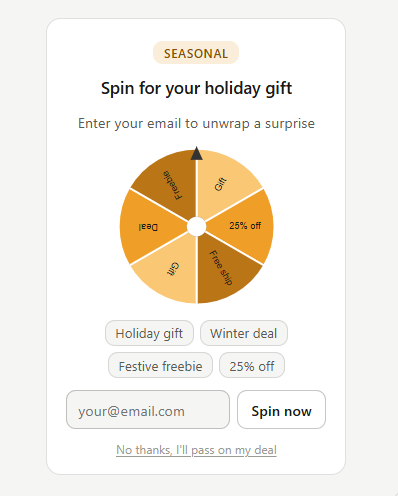
Where: Sitewide during campaign window
Trigger: 15–20 second delay or exit intent
Prizes: Holiday gift, Winter deal, Festive freebie, …
Takeaway: The same wheel running year-round gets ignored. A wheel that looks and feels like this exact moment earns the spin.
3. The Content-Unlock Wheel
Used by SaaS and content brands where prizes are entirely non-monetary. The gamified format makes a content upgrade feel more exciting than a plain email gate — no discount budget required.
The variable reward mechanic still works because the prize is something the audience genuinely wants.
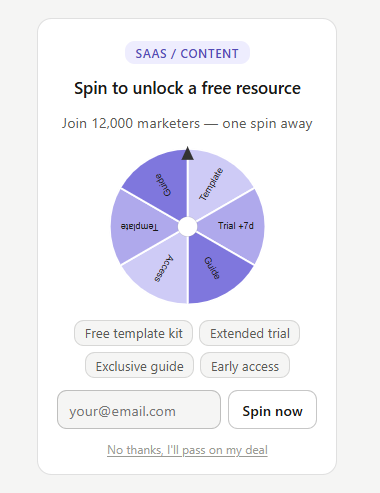
Where: Blog posts, resource pages, SaaS pricing pages
Trigger: 50–60% scroll depth or exit intent
Prizes: Free template kit, Extended trial, Exclusive guide …
Takeaway: Gamification doesn’t require a discount budget. It requires a prize your specific audience would actually want.
4. The Returning Visitor Wheel
Shown only to visitors who have been to the site more than once without buying. The ‘We saved your spin’ angle feels personal rather than generic. A returning visitor has already done the trust-building work — they just need a stronger reason to act.
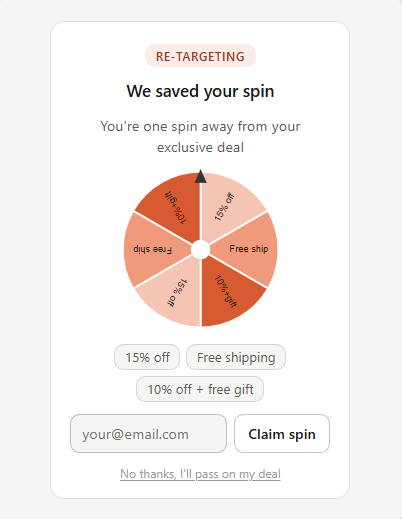
Where: Any page, targeted at returning visitors only (2+ sessions, no purchase)
Trigger: Exit intent
Prizes: 15% off, Free shipping, 10% off + free gift
Takeaway: Behavioral targeting lets you run multiple wheel campaigns simultaneously for different visitor types without any additional traffic spend.
5. The New Product Launch Wheel
All prize segments tie directly to the launch. The popup wheel becomes part of the launch event itself, not an interruption. Visitors who win early access or a launch-specific discount have an immediate reason to click through to the product page, which is exactly where you want them.
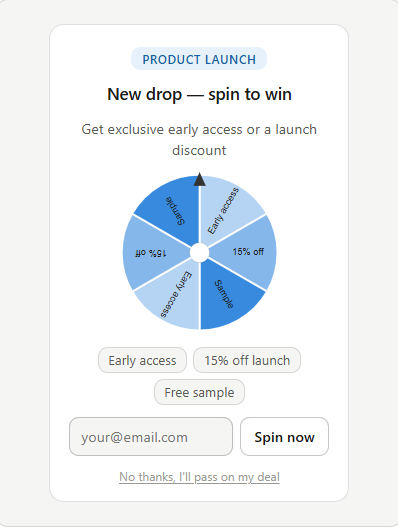
Where: New product landing page or homepage during launch window
Trigger: 20-second delay or exit intent
Prizes: Early access, 15% off launch, Free sample
Takeaway: Focused prize structures tied to a specific product turn the wheel into a launch amplifier, not just a lead capture tool.
6. The Loyalty Re-Engagement Wheel
Triggered from inside an email campaign. A link takes dormant subscribers back to the site where the wheel immediately fires. This gives cold lists a reason to re-engage that’s more exciting than a plain discount email. The spin mechanic adds anticipation that a static coupon never can.
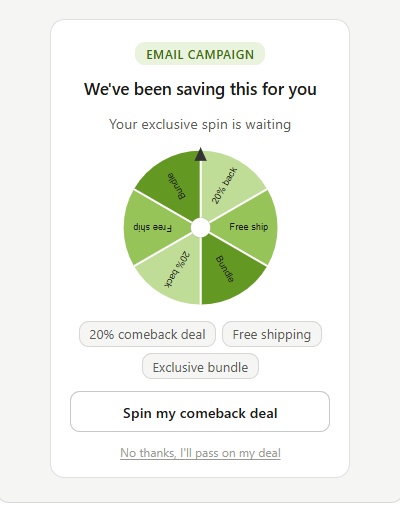
Where: On-site, triggered from an email campaign link
Trigger: URL parameter from email click activates the wheel immediately on landing
Prizes: 20% comeback deal, Free shipping, Exclusive bundle
Takeaway: The wheel isn’t limited to on-site use. It works inside email campaigns as a re-engagement mechanic for dormant subscribers.
7. The Daily Deal Wheel
Visitors spin once per day with prizes rotating daily. This turns the wheel from a one-time lead capture tool into a habitual brand touchpoint.
A visitor who checks your site five times in two weeks has a fundamentally different purchase probability than one who visited once and the daily wheel is what creates that habit.
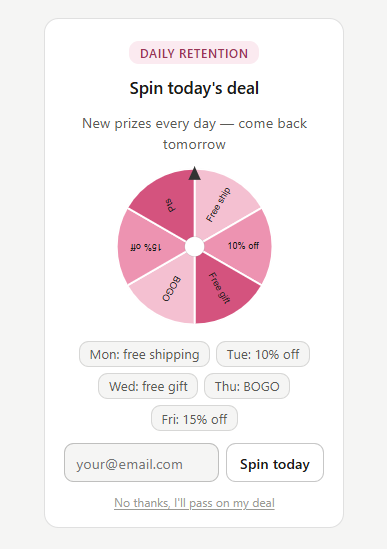
Where: Homepage or dedicated landing page
Trigger: On load. One spin per visitor per 24-hour period
Prizes: Mon: free shipping, Tue: 10% off, Wed: free gift …
Takeaway: Recurring engagement mechanics turn the wheel from a one-time conversion tool into a habitual brand touchpoint that brings visitors back daily.
What Are the Technical Requirements for a Spin Wheel Popup?
These are not optional details. They determine whether your popup wheel improves your marketing or creates problems you have to fix later.
1. Site Performance
A popup is only a marketing asset if it doesn’t cost you more in site performance than it earns in conversions. Google’s Core Web Vitals, specifically LCP (Largest Contentful Paint) and INP (Interaction to Next Paint), are ranking factors. A heavy popup script can degrade both.
What to verify:
- The popup script loads asynchronously, meaning it doesn’t block the main page from rendering.
- Script execution time is under 200ms. Reputable platforms (including Picreel) meet this standard.
- Run a Google PageSpeed Insights test before and after installing the popup. If your LCP score drops by more than 0.3 seconds, flag it with your popup provider.
- Check that the popup wheel does not trigger a Cumulative Layout Shift (CLS) by pushing page elements when it loads.
2. Mobile Responsiveness
Mobile is not a secondary screen. It is the primary screen for most of your visitors. A spin wheel that doesn’t meet mobile standards fails your largest audience segment.
Checklist before every launch:
- The wheel scales correctly within the viewport at 375px width (iPhone SE, the smallest common modern screen).
- The email input field, CTA button, and close button are all tappable at a minimum 44x44px touch target size.
- The popup never locks the full viewport without a visible exit option. This is a Google intrusive interstitials penalty risk in addition to a UX failure.
- The keyboard opening on mobile doesn’t push the popup off-screen or cover the CTA button.
- The wheel animation runs smoothly at 60fps on mid-range Android devices, not just high-end iPhones.
3. GDPR and CCPA Compliance
Privacy compliance isn’t a nice-to-have. It’s a legal requirement in the EU, UK, California, and an expanding list of other jurisdictions. A spin wheel that collects emails without proper consent exposes your business to regulatory risk.
Non-negotiable requirements:
- Include an opt-in consent checkbox below the email field. It must be unchecked by default. Pre-checked boxes are non-compliant under GDPR.
- Use plain-language consent text: “I agree to receive marketing emails. View our privacy policy.”
- The privacy policy link must be clickable and go to an actual, current privacy policy page.
- Store the consent timestamp alongside every subscriber record. If audited, you need to prove when and how consent was obtained.
- Do not pass emails to your marketing platform until consent is confirmed. Configure your integration to only sync records with a completed opt-in.
4. Anti-Fraud Protection
A high opt-in rate that produces a list full of fake emails is not a win. It’s a deliverability problem waiting to happen. These four protections keep your list clean and your coupon economics intact.
| Protection | What it does | Why it matters |
|---|---|---|
| Unique auto-generated codes | Creates a single-use code per spin | Prevents sharing on coupon aggregator sites |
| Disposable email domain filtering | Blocks addresses from temp-mail services | Stops fake submissions designed to get a code |
| One spin per device/email limit | Prevents the same person from spinning repeatedly | Protects margin against prize-chasing behavior |
| 48–72 hour coupon expiry | Creates urgency without punishing legitimate returners | Increases same-session redemption rates |
For high-traffic sites, also consider adding reCAPTCHA to the email submission step. It adds one second of friction but filters bot submissions entirely.
Is a Spin the Wheel Popup Right for Your Business?
If you step back, the takeaway is simple. Wheel of popups work because they change how people experience your offer. But results don’t come from the format alone. They come from how you set it up.
Get the basics right. Define a clear goal, trigger it at the right moment, keep your prize structure balanced, and connect it to a follow-up system that actually converts. Small tweaks here can make a big difference in outcomes.
If you want to implement this without getting into technical complexity, tools like Picreel make it easy to build, test, and optimize spin wheels across your site.
Start with one campaign, track what happens, and refine from there. That’s where the real gains show up.
Frequently Asked Questions
Do gamified popups hurt brand perception?
It depends entirely on your brand positioning. For B2C categories like fashion, beauty, gadgets, and home goods, wheel of popups feel fun and relevant. For luxury brands, professional services, or B2B companies where authority and prestige matter, they can undermine the premium feel. If you're unsure, run an A/B test against a clean, minimal popup wheel and let your audience tell you.
How many prize segments should a spin wheel have?
Five to eight is the practical range. Fewer than five makes the wheel look visually thin and reduces the perception of variety. More than eight makes each segment too narrow on mobile screens, which creates usability problems. Each segment should have a distinct color to make the spin feel visually dynamic and worth watching.
What is the best way to reduce low-quality email submissions on a spin wheel?
Use three layers of protection: disposable email domain filtering to block temporary addresses, unique single-use coupon codes so sharing the code doesn't bypass the opt-in, and a confirmed opt-in requirement tied to your email platform's double opt-in setting for subscribers who open and click the follow-up email.
How do I know if the spin wheel is attracting buyers or just discount hunters?
Track the 90-day open rate and purchase rate of subscribers who came through the wheel versus other opt-in sources. If wheel subscribers open emails but never buy, your prize structure is attracting discount-motivated sign-ups rather than purchase-intent customers. Adjust by shifting more wheel probability toward non-discount prizes like free shipping or loyalty points.
Is a spin wheel popup effective for cart abandonment specifically?
It is one of the highest-converting placements for a spin wheel. Trigger it on the cart or checkout page using exit intent for visitors who have items in their cart. Prize segments focused on free shipping or a direct percentage off the cart total address the most common reasons visitors abandon (cost concerns) and can recover a meaningful percentage of those sessions.
What should I do if my spin wheel is slowing down my website?
Check whether your popup platform loads its script asynchronously. If the script is render-blocking, it will degrade your Core Web Vitals and hurt both user experience and SEO. A well-built popup tool loads in under 200ms without impacting LCP. If performance issues persist, contact your platform's support team or consider switching to a tool with a lighter script footprint.
How long should a coupon code from a spin wheel remain valid?
48 to 72 hours is the recommended window. This is short enough to create genuine urgency, which increases same-session purchase intent, but long enough that a visitor who leaves and comes back the next day can still redeem their prize. Codes that expire in 24 hours or less often feel punishing and can create negative brand sentiment.
FREE. All Features. FOREVER!
Try our Forever FREE account with all premium features!

 We'd love your feedback!
What did you like & how can we make it even better?
 Thanks for your feedback!
 Ask Your Question
Have a question? Get expert help to make your decision easier.